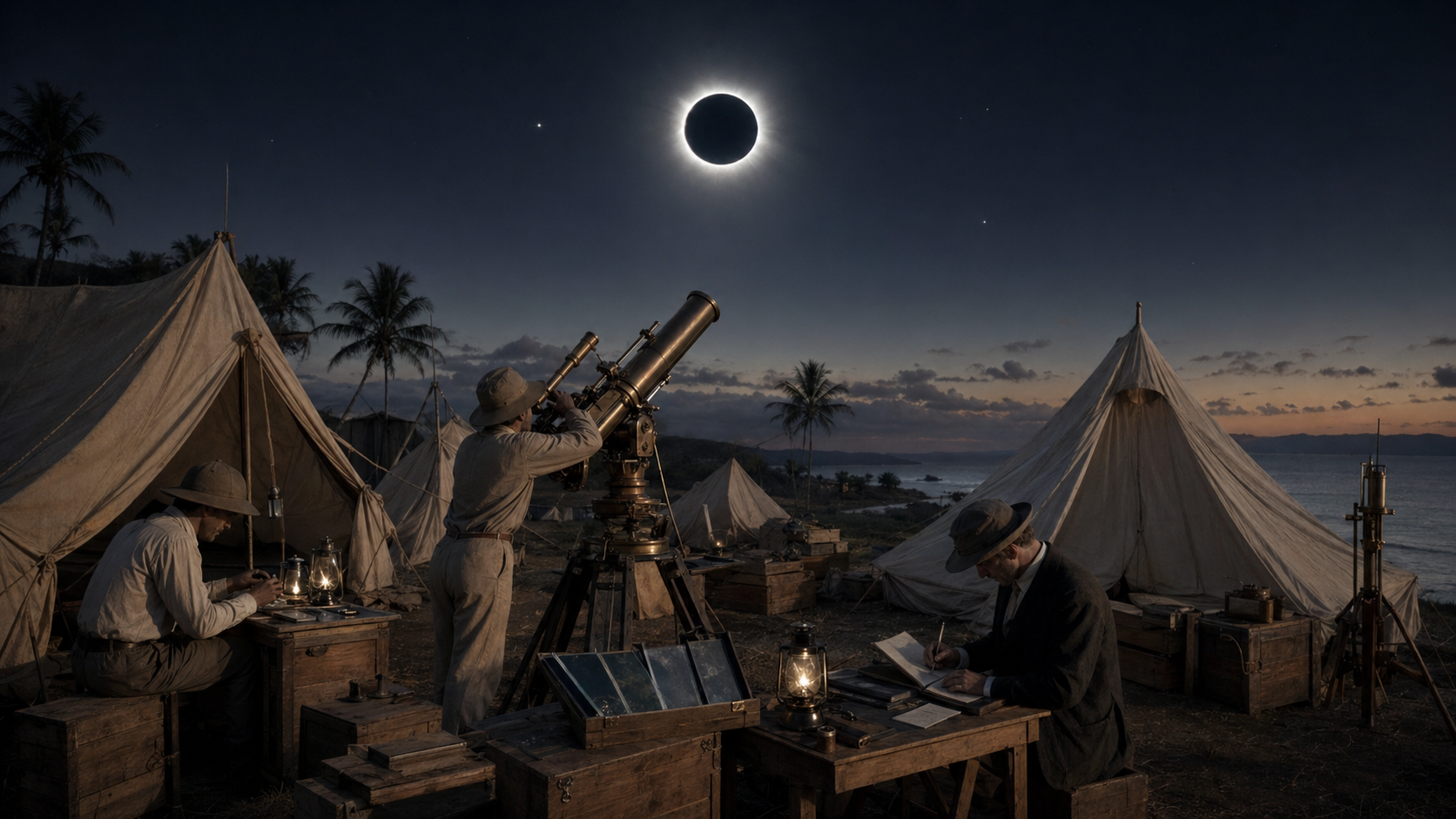
L'éclipse totale de Soleil du 29 mai 1919 est devenue l'une des expériences les plus célèbres de l'histoire des sciences.
La théorie de la relativité générale d'Albert Einstein prédisait que la gravité n'est pas seulement une force qui rassemble des objets. C'est aussi une courbure de l'espace et du temps. Si cela était vrai, la lumière passant à proximité d’un objet massif comme le Soleil devrait légèrement se courber.
Le problème était la visibilité. Les étoiles proches du Soleil sont normalement cachées par la lumière du jour. Lors d'une éclipse solaire totale, la Lune bloque la face lumineuse du Soleil, le ciel s'assombrit et les étoiles proches du Soleil peuvent être photographiées.
Cette brève obscurité a permis aux astronomes de tester l'idée d'Einstein.
Ce qu'Einstein a prédit
Si le Soleil courbe la lumière des étoiles, une étoile vue près du Soleil lors d’une éclipse devrait apparaître légèrement décalée par rapport à sa position normale.
Le déplacement est infime : mesuré en secondes d’arc et non en degrés. Il est beaucoup trop petit pour être remarqué à l’œil nu. Les astronomes avaient besoin de photographies du champ d'étoiles pendant la totalité, puis de photographies comparatives des mêmes étoiles lorsque le Soleil était ailleurs dans le ciel.
La gravité newtonienne suggère également une possible déviation de la lumière, mais la théorie d'Einstein prédit une ampleur différente. L’expédition de 1919 a été conçue pour distinguer ces possibilités.
Les expéditions d'éclipse de 1919
Le chemin de la totalité a traversé l’Amérique du Sud, l’Atlantique et l’Afrique. Des équipes britanniques ont organisé des observations depuis Sobral, Brésil et l'île de Principe au large de la côte ouest de l'Afrique.
Les expéditions sont généralement associées à Arthur Eddington, mais les travaux impliquaient également Frank Dyson, Charles Davidson, Andrew Crommelin et d'autres. L'objectif était pratique et difficile : transporter des équipements délicats, installer des observatoires temporaires, survivre aux nuages et aux intempéries, photographier les étoiles pendant quelques minutes de totalité et mesurer ensuite de minuscules changements de position.
A Principe, les nuages rendaient les observations difficiles. À Sobral, certains instruments ont mieux fonctionné que d’autres. Le résultat final dépendait d’une mesure et d’une comparaison minutieuses des plaques.
Ce que l'éclipse a montré
Les résultats combinés ont été annoncés à Londres le 6 novembre 1919 lors d'une réunion conjointe de la Royal Society et de la Royal Astronomical Society.
Les mesures soutiennent plus fortement la prédiction d'Einstein que l'alternative newtonienne. Les journaux ont rapidement transformé le résultat technique en une histoire mondiale : une nouvelle théorie de la gravité avait passé avec succès un test d'éclipse dramatique.
Cette réaction du public a contribué à rendre Einstein célèbre bien au-delà de la physique.
Aujourd'hui, les scientifiques décriraient le résultat avec plus de soin que « une seule éclipse a tout prouvé ». Il s’agissait d’un premier test important, et non du dernier mot sur la relativité. Les mesures ultérieures, la radioastronomie, le suivi des engins spatiaux, les observations par lentille gravitationnelle, les pulsars et les détections d’ondes gravitationnelles ont tous renforcé ces arguments.
Mais l’éclipse de 1919 reste emblématique car elle a transformé une théorie abstraite en quelque chose de visible : des étoiles déplacées par la gravité du Soleil.
Pourquoi la totalité comptait
L'expérience devait être complète, car la brillante photosphère du Soleil submerge les étoiles proches. Une éclipse partielle ne créerait pas suffisamment d’obscurité. Une éclipse annulaire laisserait quand même un brillant anneau de lumière solaire. Seule la totalité pourrait révéler le champ d'étoiles proche du Soleil.
C’est la même raison pour laquelle les éclipses totales de Soleil sont utiles pour étudier la couronne. La Lune agit comme un disque occultant naturel, cachant la surface brillante et révélant de faibles détails qui sont généralement perdus dans l'éblouissement.
Une histoire scientifique avec des limites humaines
L’expédition de 1919 est aussi une histoire humaine. Les observations ont eu lieu juste après la Première Guerre mondiale, lorsque la coopération scientifique entre la Grande-Bretagne et l’Allemagne était politiquement tendue. Eddington, quaker et pacifiste, a participé à l’histoire de la reconstruction de la science internationale.
Les mesures étaient difficiles, les données imparfaites et les historiens ultérieurs ont examiné l'analyse en détail. Cela ne rend pas l’expérience sans importance. Cela en fait une véritable science : un test difficile, réalisé avec les meilleurs outils disponibles, puis revisité avec de meilleures méthodes.
En 1979, une réévaluation des plaques originales a largement conforté la conclusion initiale. L'astronomie moderne observe désormais régulièrement la courbure gravitationnelle sous le nom de lentille gravitationnelle.
Sources et guides associés
- [Relativité générale et éclipse solaire de 1919] de l'Observatoire royal de Greenwich (https://www.royalobservatorygreenwich.org/articles.php?article=1283) donne un compte rendu détaillé des expéditions et l'annonce des résultats.
- L'[Histoire des éclipses] de la NASA (https://science.nasa.gov/eclipses/history/) résume comment l'éclipse de 1919 a validé la théorie d'Einstein pour le public.
- Guides SolarWatch associés : la couronne solaire, comment fonctionnent les prévisions d'éclipse, temps de contact des éclipses et sécurité des éclipses solaires.
Voir dans SolarWatch
SolarWatch ne peut pas contrôler la lumière des étoiles à votre place, mais il peut montrer pourquoi l'expérience de 1919 dépendait du lieu et du moment. Utilisez le catalogue et les circonstances locales pour voir comment la totalité crée une courte fenêtre d'observation spécifique à un lieu.