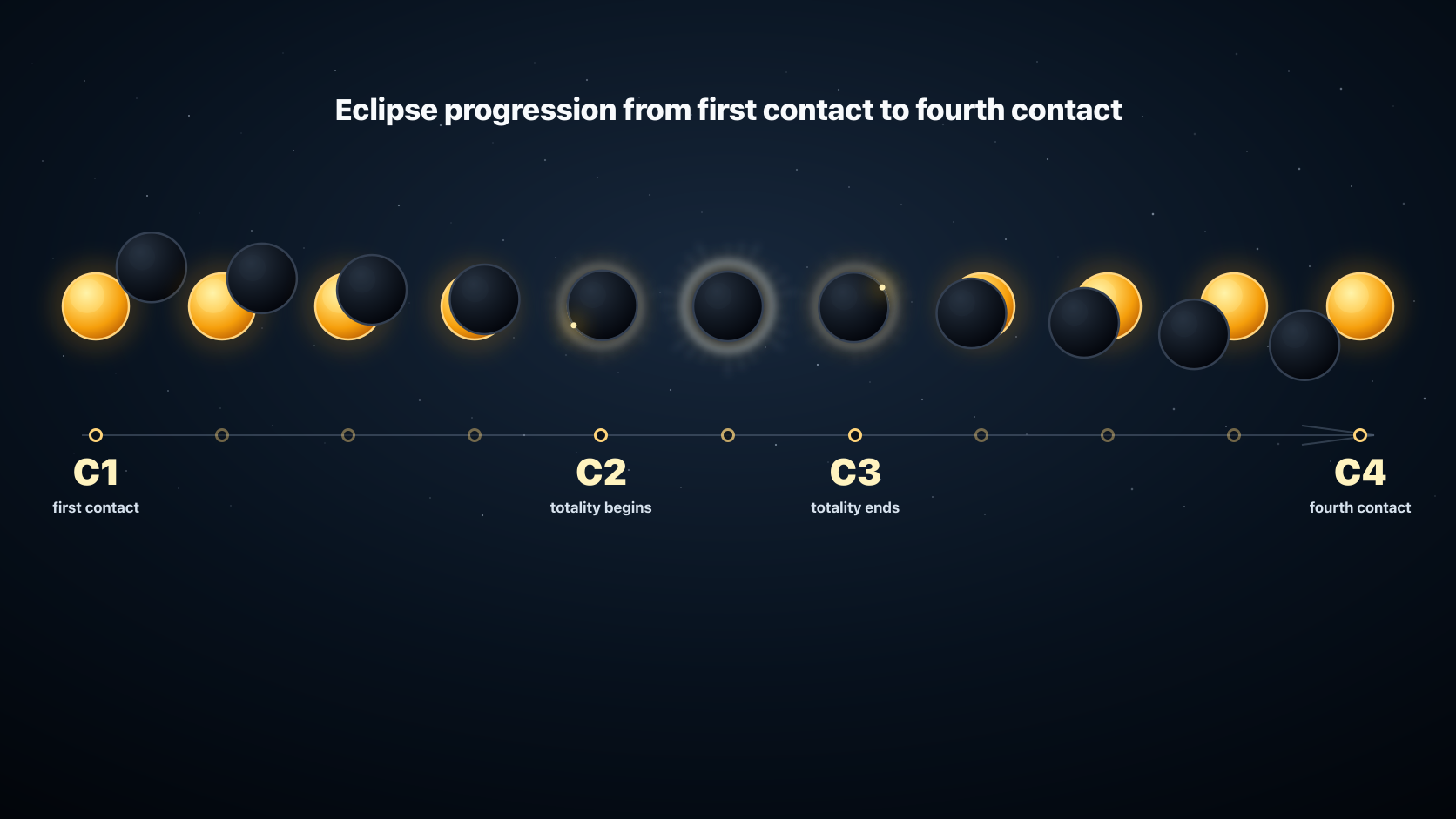
Eclipse guides often mention C1, C2, C3, and C4. These are the four contact points of a solar eclipse: the moments when the apparent edges of the Sun and Moon first touch, fully overlap for totality, separate from totality, and finally stop touching.
The contact points are not just astronomy jargon. They are the timeline that tells you when the eclipse starts, when totality begins, when totality ends, and when the event is over from your location.
C1: first contact
C1, or first contact, is the moment the Moon first appears to touch the Sun's edge. From then on, the Sun slowly looks as if a bite is being taken out of it.
For most observers, C1 is subtle. You need certified eclipse glasses or a safe indirect method to see it. Without protection, you should not try to look for the first bite directly.
C1 begins the partial phase. Solar filters are required for direct viewing, and cameras, binoculars, and telescopes need proper front-mounted solar filters.
C2: second contact
For a total eclipse, C2, or second contact, happens only for observers inside the path of totality. It is the moment totality begins: the Moon fully covers the Sun's bright photosphere.
Just before C2, sunlight may break into Baily's beads along the rugged edge of the Moon. The last bright bead can create the diamond ring effect. Once the final direct sunlight disappears and totality is established, it is safe to view the eclipsed Sun without glasses for a short time.
This is the transition everyone plans around. If you are photographing the eclipse, C2 is when exposure settings and filters change. If you are guiding a group, C2 is when your safety instructions need to be calm and exact.
Annular eclipses also have C2 and C3, but those contacts mark the beginning and end of annularity rather than totality. The Sun is still not safe to view without proper filters during annularity.
Maximum eclipse
Maximum eclipse is not one of the four contacts, but it is usually listed with them. It is the moment when the eclipse is deepest from your location.
For a total eclipse, maximum occurs during totality. For a partial eclipse, it is when the Moon covers the largest fraction of the Sun. This is also when magnitude, obscuration, and Sun altitude are often reported.
C3: third contact
C3, or third contact, is when totality ends. The Moon begins to uncover the bright solar surface, and direct sunlight returns.
This is the most important safety moment of the eclipse. The reappearance of the diamond ring or bright beads means naked-eye viewing is over. Look away and put eclipse glasses back on before the Sun returns.
For photographers, C3 is another fast transition. Solar filters go back on for the remaining partial phase.
C4: fourth contact
C4, or fourth contact, is the end of the eclipse. The Moon's disk no longer overlaps the Sun. After C4, the Sun appears normal again.
By this point, the dramatic part is over, but C4 is still useful for observation logs, school activities, and comparing the full local duration of an eclipse from different places.
Contact times are local
The most important thing to remember is that contact times change with location. A schedule for one city is not reliable for another city, even during the same eclipse.
Near the edge of the path, totality may be very short or may disappear entirely. Near the centerline, totality usually lasts longer. Elevation and horizon also matter when the Sun is low.
Sources and related guides
- NASA GSFC's solar eclipse geometry guide explains the shadow regions and central path that determine local contacts.
- NASA's detailed eclipse publications show how contact times are computed from local circumstances.
- Related SolarWatch guides: the path of totality, shadow bands, Baily's beads, and solar eclipse safety.
See it in SolarWatch
SolarWatch shows C1, C2, maximum eclipse, C3, and C4 for the selected location. Use the local contact timeline to plan eye protection, photography settings, reminders, and the exact moments when totality begins and ends.