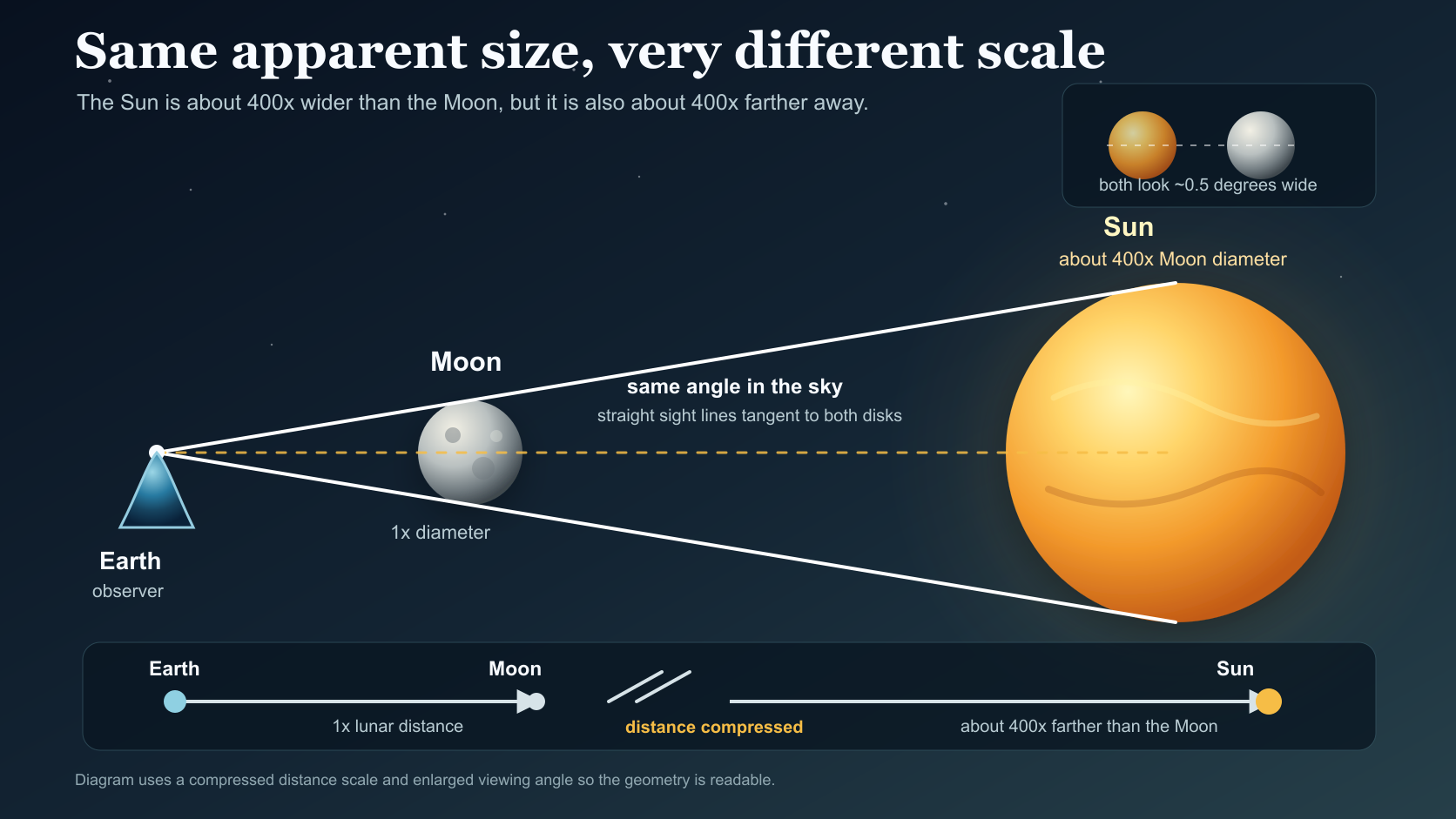
The Moon and the Sun look almost the same size in our sky, but they are not actually the same size. The Sun is enormous. The Moon is tiny by comparison. The reason they appear similar is distance.
The Sun is about 400 times wider than the Moon, and it is also about 400 times farther from Earth. Those two ratios nearly cancel out. From our point of view, the disks of the Sun and Moon both appear about half a degree wide.
That coincidence is the reason total solar eclipses can happen.
Apparent size is about angle
When you hold your thumb at arm's length, it can cover a distant building. Your thumb is not bigger than the building. It only takes up a similar angle in your view.
Astronomers call this angular size or apparent size. It depends on both the real size of an object and its distance from the observer.
The Moon is close enough that its small disk can cover the much larger but much more distant Sun. During a total solar eclipse, the match is so good that the Moon hides the bright solar surface while leaving the faint corona visible around it.
The match is not perfect
The Moon's orbit around Earth is elliptical, not a perfect circle. Sometimes the Moon is closer to Earth, near perigee. Sometimes it is farther away, near apogee.
When the Moon is closer, it looks slightly larger and can cover the Sun completely if the alignment is right. That produces a total solar eclipse.
When the Moon is farther away, it looks slightly smaller. If it passes centrally across the Sun at that distance, it cannot cover the whole solar disk. A bright ring remains visible around the Moon, producing an annular eclipse.
This is why two eclipses can have similar alignments but different appearances.
The Sun changes apparent size too
Earth's orbit around the Sun is also slightly elliptical. The Sun appears a little larger when Earth is near perihelion in early January and a little smaller near aphelion in early July.
That change is smaller than the Moon's apparent-size change, but it still matters in eclipse geometry. Eclipse predictions account for the sizes and distances of both bodies.
Totality is a temporary coincidence
The Moon is slowly moving away from Earth over geological time. In the distant future, the Moon will appear too small to cover the Sun completely. Total solar eclipses will no longer happen on Earth, though annular eclipses will continue.
Right now, we live in a lucky era. The Moon is at just the right range of distances to sometimes cover the Sun exactly, creating totality, and sometimes appear too small, creating annularity.
Why the corona appears
The Sun's visible surface is so bright that it overwhelms the much fainter outer atmosphere, called the corona. During totality, the Moon blocks that bright surface. Because the apparent sizes match so closely, the corona can shine around the edge of the Moon.
If the Moon looked much larger, it would hide more of the inner corona. If it looked much smaller, the Sun's bright surface would remain visible and wash out the corona.
The spectacle depends on the fit.
Why this is easy to miss
Our brains are not good at judging real size from the sky alone. The Sun and Moon both look small because they are far away, and there are few everyday objects in the sky to compare them with. Eclipses make the comparison obvious. The Moon approaches the Sun, their edges line up, and the near-equal apparent size becomes something you can actually watch.
Sources and related guides
- NASA GSFC's solar eclipse geometry explains why the Moon's apparent size determines total, annular, and hybrid eclipses.
- NASA's Moon's Moment in the Sun explains the 400-times size and distance coincidence behind totality.
- Related SolarWatch guides: what a solar eclipse is, the four types of solar eclipse, the solar corona, and Baily's beads.
See it in SolarWatch
SolarWatch shows whether an eclipse is total, annular, partial, or hybrid, and the local circumstances explain what that means from a selected location. Use the catalog to compare total and annular eclipses and see how small changes in apparent size create very different events.