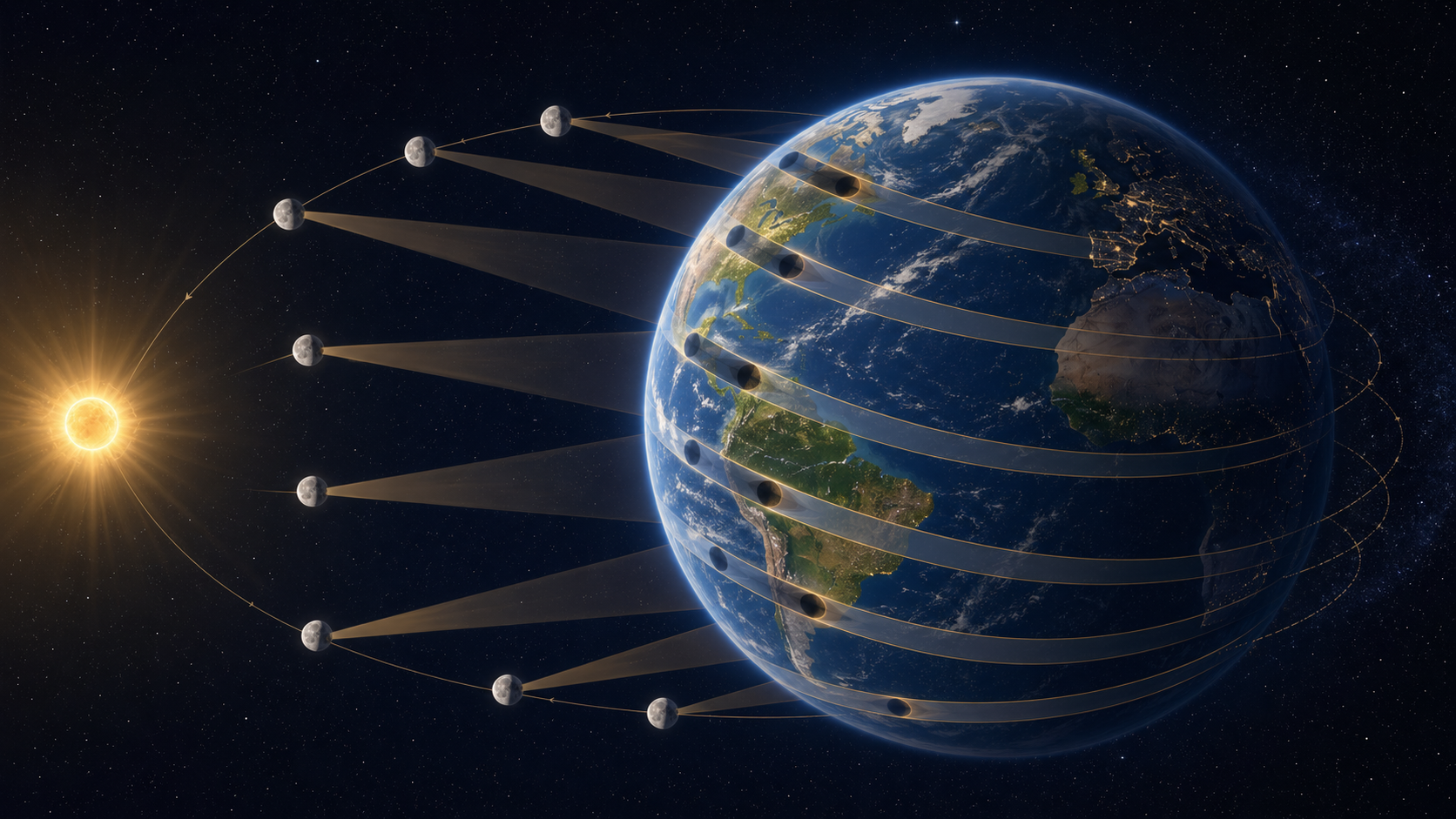
The Saros cycle is one of the most famous patterns in eclipse prediction. After about 18 years, 11 days, and 8 hours, the Sun, Earth, and Moon return to a very similar geometry. That means a related eclipse can happen again.
The cycle is not magic. It is the result of several lunar rhythms lining up almost, but not perfectly.
Three lunar clocks
To understand the Saros, it helps to know that the Moon has more than one useful "month."
The synodic month is the time from one new Moon to the next, about 29.5 days. Solar eclipses can only happen near new Moon.
The draconic month is the time it takes the Moon to return to the same node, one of the places where its tilted orbit crosses Earth's orbital plane. Eclipses require the Moon to be near a node.
The anomalistic month is the time it takes the Moon to return to the same part of its elliptical orbit, such as perigee. This affects the Moon's apparent size and therefore whether an eclipse can be total or annular.
After 223 synodic months, these cycles nearly line up. That is one Saros.
Why related eclipses look similar
Because the geometry repeats, eclipses separated by one Saros often share important traits. They may happen at a similar time of year, with the Moon at a similar distance from Earth, and with a similar alignment to the node.
That is why a Saros series can contain a family of related eclipses. A series may begin with small partial eclipses near one polar region, develop into central eclipses, and eventually fade out with partial eclipses near the opposite polar region.
For example, Saros 145 produced the August 21, 2017 total solar eclipse across North America and will produce the August 2, 2027 total eclipse over parts of North Africa and the Middle East. The two eclipses are related, but their paths are very different.
Why the path moves
The Saros includes an extra 8 hours, or roughly one third of a day. During those 8 hours, Earth rotates about one third of the way around.
So the next eclipse in a Saros series does not occur over the same longitude. Its path is shifted far to the west. This is why the Saros predicts a related eclipse, not a repeat over the same cities.
After three Saros cycles, about 54 years and 34 days, the extra 8-hour shifts add up to nearly a full day. This longer pattern is sometimes called an exeligmos, and it brings eclipse paths closer in longitude again.
Ancient prediction and modern calculation
Ancient Babylonian astronomers recognized eclipse patterns through careful records. They did not need spacecraft or computers to notice that eclipses came in families. Long-term observation was enough to reveal the rhythm.
Modern eclipse prediction goes much further. It uses precise orbital models, Earth's shape, lunar terrain, and time standards to calculate contact times and paths. The Saros remains useful as a way to understand the pattern, but detailed predictions require more than the cycle alone.
What the Saros can and cannot tell you
The Saros can tell you that an eclipse belongs to a repeating family. It can help explain why eclipses cluster into recognizable series.
It cannot tell you by itself whether your city will see totality, what time first contact occurs, how high the Sun will be, or whether the eclipse will be visible above your horizon. Those are local circumstances.
A pattern, not a shortcut
The best way to think about the Saros is as a family resemblance. Related eclipses share geometry, but they are not copies. Earth's rotation, the Moon's changing distance, the season, and the observer's location all still matter.
That is why the Saros is excellent for understanding eclipse history and long-term patterns, while maps and local calculations are essential for planning an actual viewing trip.
Sources and related guides
- NASA GSFC explains the periodicity of solar eclipses, including the Saros and related lunar months.
- NASA's future eclipse listings show how eclipse families still land in different places across years.
- Related SolarWatch guides: why a solar eclipse does not happen every month, how eclipse predictions work, and the August 12, 2026 eclipse.
See it in SolarWatch
SolarWatch's Solar Eclipse Catalog covers every solar eclipse from 2000 to 2200. Use it to browse eclipse families, compare paths across decades, and then open local circumstances to see what a global eclipse means for one specific place.