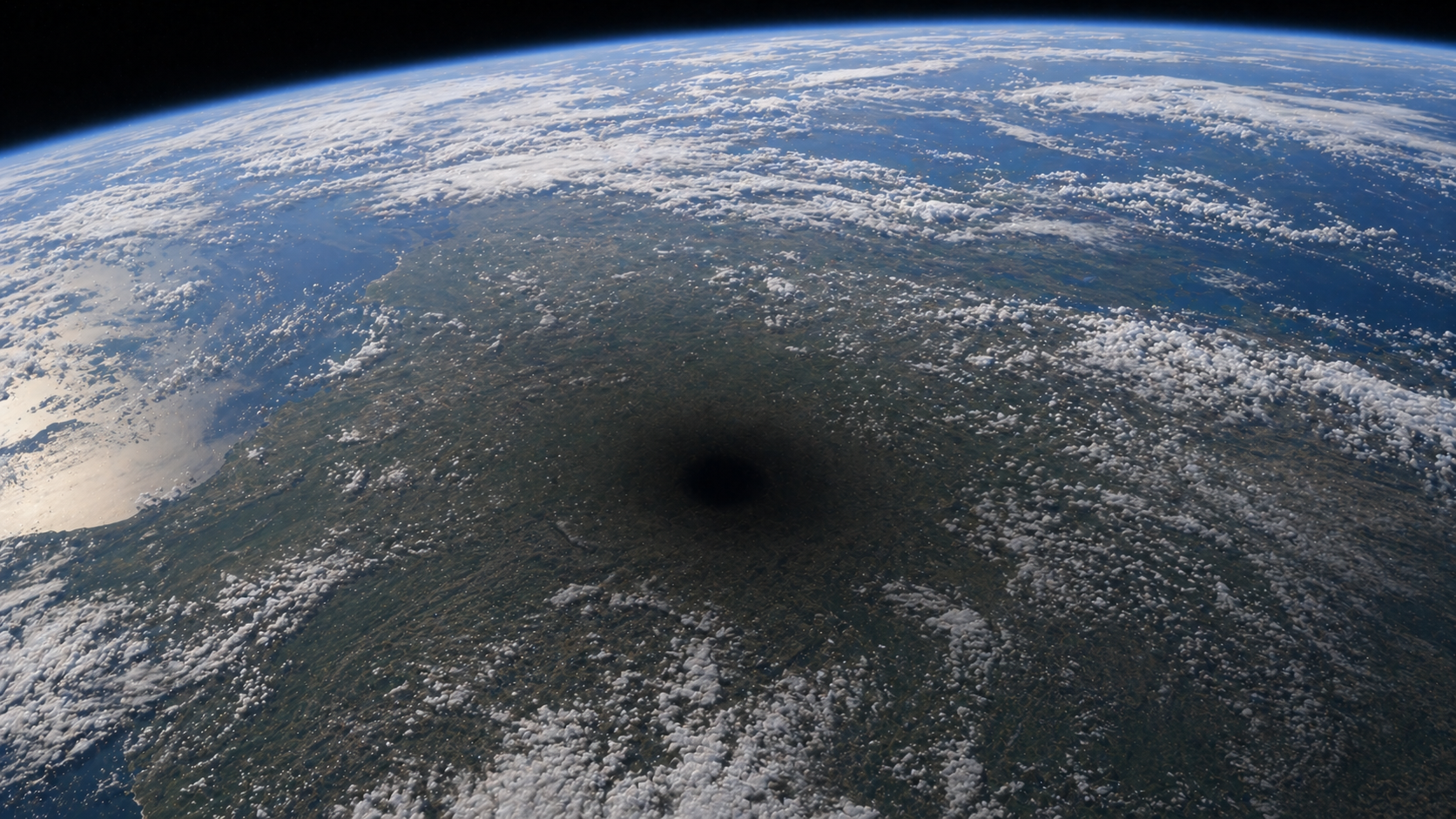
The path of totality is the narrow track on Earth where a total solar eclipse is visible. If you stand inside it, the Moon can completely cover the Sun for a short time. If you stand outside it, even nearby, you see only a partial eclipse.
That difference is enormous. A 99% partial eclipse is still not totality. The Sun's bright surface remains visible, the corona stays hidden, and eclipse glasses must stay on.
The path is made by the umbra
During a total solar eclipse, the Moon casts a shadow with a dark center and a lighter outer region.
The dark central shadow is the umbra. Where the umbra touches Earth, observers see totality. The lighter outer shadow is the penumbra. Where the penumbra reaches Earth, observers see a partial eclipse.
The path of totality is the trail made as the umbra moves across Earth's surface. On a map it looks like a long narrow ribbon, but the actual shadow footprint at any instant is more like an oval spot moving over a curved planet.
Why the path is narrow
The Moon is much smaller than the Sun, but it is also much closer to Earth. That size-and-distance coincidence lets it cover the Sun from our viewpoint. The fit is close, which means the darkest part of the shadow is not very wide when it reaches Earth.
NASA describes the path of totality as usually less than 150 miles wide. The exact width depends on the Moon's distance from Earth, Earth's distance from the Sun, and the angle at which the shadow meets Earth's surface.
Near the centerline, totality usually lasts longer. Near the edge, the Moon barely covers the Sun completely, so totality can be much shorter. A small change in position can mean gaining or losing precious seconds.
The shadow moves quickly
The Moon's shadow does not sit still. The Moon is orbiting Earth, Earth is rotating, and both are moving around the Sun. Combined, that motion sweeps the umbra across the planet.
The ground speed varies from eclipse to eclipse and from one part of the path to another. NASA measurements and examples commonly put the lunar shadow at thousands of kilometers per hour. For trip planning, the practical point is simple: totality arrives on a schedule, lasts only minutes, and then moves on.
This is why contact times matter. First contact, second contact, maximum eclipse, third contact, and fourth contact are local times for a specific place. They are not interchangeable between cities.
Centerline, edge, and weather
Eclipse maps often show a centerline because it is the middle of the totality path. The centerline is usually a strong planning target, but it is not the only factor.
You also need a clear view of the Sun. Terrain, buildings, tree lines, and the Sun's altitude can make or break a viewing site. Weather matters too. A location with slightly shorter totality but better sky prospects may be the smarter choice than a cloudy centerline spot.
The edge of the path has its own appeal for some observers because Baily's beads and the diamond ring effect can last longer there. For a first total eclipse, though, most people should prioritize being comfortably inside the path so a GPS error, traffic detour, or map-reading mistake does not leave them outside totality.
August 2026 example
The August 12, 2026 total solar eclipse is a good example of why the path matters. The eclipse crosses parts of the Arctic, Greenland, Iceland, the Atlantic, and Spain. Cities and islands near the path can have very different local circumstances.
For Western Europe, the most useful question is not just "Is there an eclipse?" It is "Am I inside the totality path, and what are my local contact times?" That is the difference between watching the Sun become a crescent and seeing the corona around a fully eclipsed Sun.
Sources and related guides
- NASA's solar eclipse guide explains that totality is visible only inside a long, narrow path, usually less than 150 miles wide.
- NASA GSFC explains solar eclipse geometry, including the umbra, penumbra, and central paths.
- NASA JPL describes satellite observations of the Moon's shadow and gives an example shadow speed of about 2,668 kilometers per hour.
- Plan with the August 12, 2026 eclipse guide, eclipse contact times, solar eclipse safety, and the four types of solar eclipse.
See it in SolarWatch
Open an eclipse in SolarWatch and inspect the interactive path map. Tap a city or viewing site to see whether it is inside the path of totality, how long totality lasts, and the exact contact times for that location.