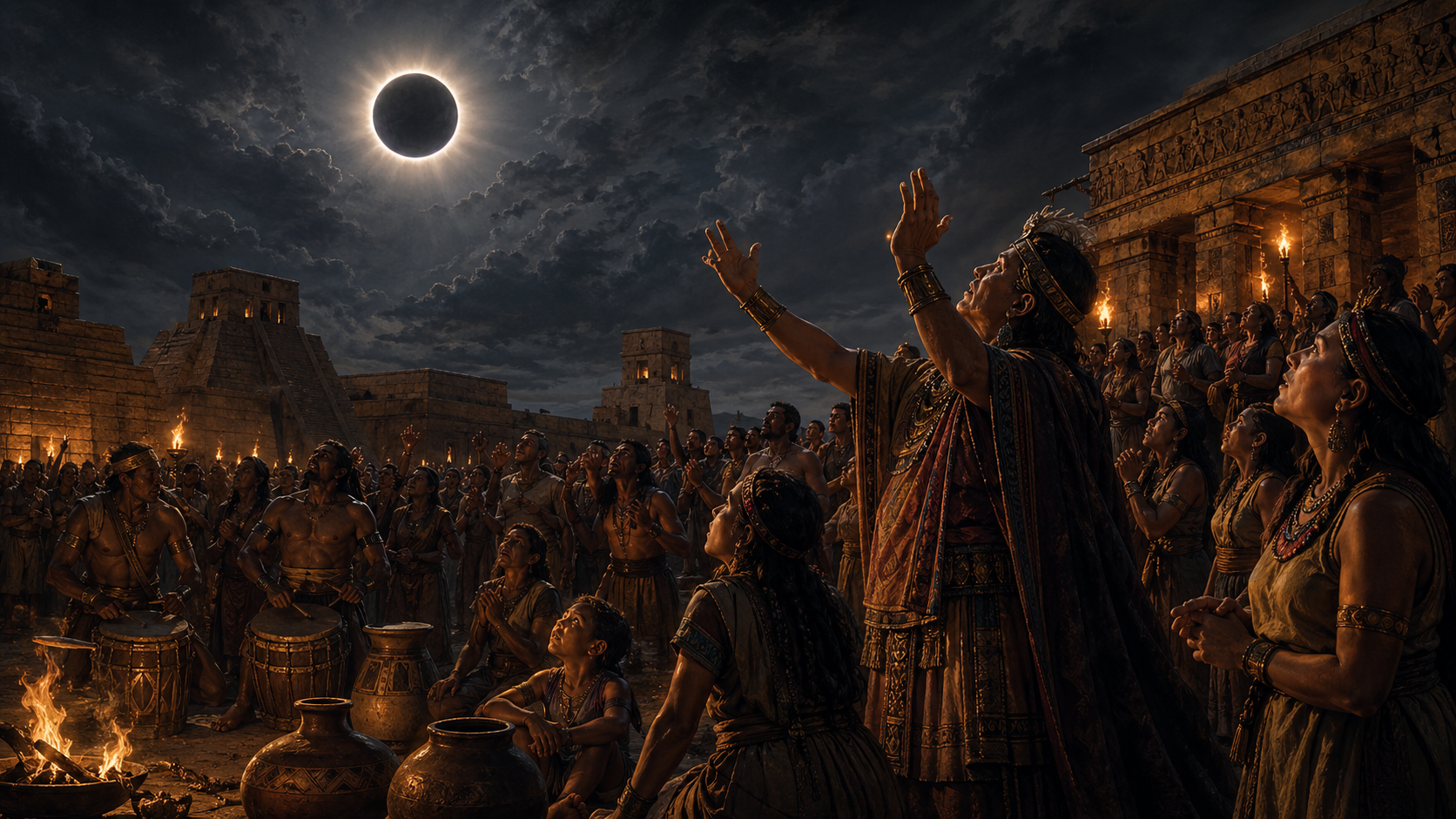
Before people could predict eclipses, a total solar eclipse could feel like the world had broken. The Sun vanished in the middle of the day, birds quieted, the air cooled, and the horizon glowed like twilight. It is no surprise that cultures created powerful stories to explain what they saw.
Those stories are not failed science. They are human attempts to make meaning from a rare and dramatic sky event. Today we can explain eclipses with orbital geometry, but the old myths still tell us how unforgettable totality can be.
Dragons eating the Sun
One of the best-known eclipse themes is a creature swallowing the Sun. In some Chinese traditions, a dragon was said to devour the Sun during an eclipse. People made noise with drums, pots, and shouting to scare the dragon away and bring daylight back.
This story makes emotional sense. During a partial eclipse, the Sun really does look as if something is taking a bite from it. During totality, the bite becomes complete, and the Sun's face disappears.
Wolves, dogs, and sky chasers
In Norse mythology, the Sun and Moon were pursued by wolves. An eclipse could be understood as one of those wolves catching its target for a moment. Other cultures told stories of dogs, jaguars, frogs, or other powerful beings disturbing the Sun.
The details changed from place to place, but the pattern was similar: an eclipse was not random darkness. It was a chase, a battle, or a warning in the sky.
Rahu, Ketu, and severed shadows
In Hindu mythology, eclipses are often connected with Rahu and Ketu, shadowy figures associated with the points where the Moon's orbit crosses the Sun's path. That connection is striking because modern eclipse prediction also depends on the lunar nodes, even though it explains them with orbital geometry rather than myth.
Inca solar traditions
In the Inca world, the Sun was central to religion, authority, and agriculture. A darkened Sun could be interpreted as a serious sign that required ritual attention. Like many eclipse traditions, the response joined sky observation with community action.
Fear, noise, and community
Many eclipse traditions involved people gathering and making noise. From a modern perspective, the sound did not change the Moon's orbit. But as a community response, it mattered.
Imagine seeing totality without warning. The temperature drops. The Sun becomes a black disk. The familiar daytime world suddenly feels strange. A shared ritual gave people something to do together while they waited for the light to return.
That return of sunlight also made the story feel true. The dragon left. The wolf released the Sun. The sky recovered.
From myth to prediction
Over time, careful sky-watchers noticed that eclipses were not completely unpredictable. Ancient astronomers recorded patterns in the Moon's motion and the timing of eclipses. The Saros cycle, roughly 18 years long, became one way to recognize when similar eclipses might return.
That shift did not erase cultural stories overnight. Myth, ritual, and calculation often lived side by side. A society could keep its sky stories while also learning that eclipses follow patterns.
Why eclipse myths still matter
Eclipse myths are useful in classrooms because they connect science to history, language, art, and culture. A child can start with the image of a dragon eating the Sun, then learn why the Sun appears bitten: the Moon is crossing the Sun's disk from our point of view.
The myth becomes a doorway. First comes the story, then the observation, then the model.
The modern story
Today, our eclipse story is written with shadows. The Moon passes between Earth and the Sun. Its penumbra creates a partial eclipse over a wide region. Its umbra creates totality along a narrow path. The event is rare at any one location, but predictable across centuries.
That explanation does not make eclipses less amazing. If anything, it makes them richer. We can know exactly when the shadow will arrive and still feel the same surprise humans have felt for thousands of years.
Sources and related guides
- Britannica surveys several cultural explanations in The Sun Was Eaten.
- Smithsonian Magazine's Indigenous eclipse beliefs overview adds cultural context for eclipse stories and interpretation.
- Related SolarWatch guides: what a solar eclipse is, solar eclipse safety, the Saros cycle, and how eclipse predictions work.
See it in SolarWatch
Use SolarWatch's Moon shadow simulation to show the modern version of the ancient story: not a dragon eating the Sun, but the Moon's shadow racing across Earth. The effect is just as dramatic, and now you can see why it happens.