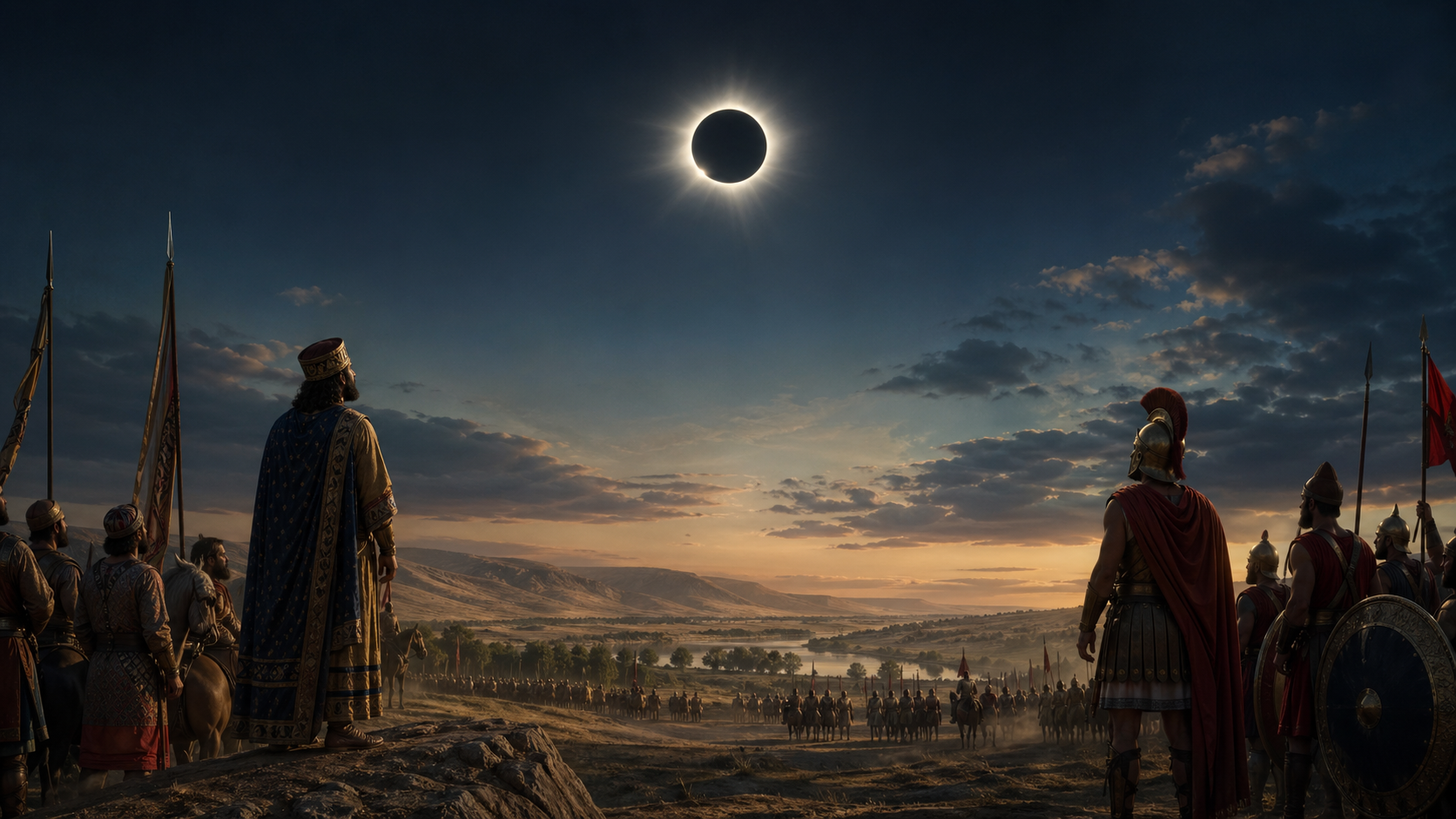
Una de las historias de eclipses más famosas dice que un eclipse solar detuvo una batalla.
Según la tradición, los lidios y los medos llevaban años en guerra cuando, durante una batalla cerca del río Halys, el día se volvió de repente noche. Los soldados interpretaron el eclipse como una señal y dejaron de luchar. La paz llegó poco después.
La historia suele asociarse con el eclipse solar del 28 de mayo de 585 a. C. y con Tales de Mileto, a quien algunas fuentes antiguas atribuyen una predicción del eclipse. Como muchas historias antiguas, mezcla historia, memoria, astronomía y debate.
Quiénes luchaban
Los lidios y los medos eran potencias regionales de Anatolia y zonas cercanas. Su conflicto formaba parte de un mundo de reinos, alianzas y fronteras cambiantes.
Una batalla en ese contexto no era solo un choque militar; también era un evento político. Un oscurecimiento repentino del Sol en pleno combate podía sentirse como una intervención divina o una advertencia.
Para personas que no tenían una explicación física moderna, un eclipse total o muy profundo era una experiencia enorme. Incluso hoy, sabiendo qué ocurre, la totalidad puede resultar sobrecogedora.
¿Fue el eclipse de Tales?
La tradición dice que Tales predijo el eclipse. Esa afirmación es famosa, pero difícil de evaluar.
Los astrónomos antiguos podían reconocer ciclos y posibilidades de eclipses, especialmente gracias a registros de larga duración. Pero predecir la fecha exacta y la visibilidad local de un eclipse solar concreto era muy difícil sin herramientas modernas.
Una posibilidad es que Tales o quienes influyeron en la tradición conocieran patrones de eclipses y anticiparan una temporada o posibilidad general. Otra es que la historia se simplificara después, convirtiendo una coincidencia o predicción parcial en una predicción precisa.
Por qué los eclipses solares eran difíciles de predecir
Los eclipses lunares son visibles desde una región muy amplia de la Tierra. Los solares, en cambio, dependen de una sombra estrecha. Un eclipse solar puede ocurrir globalmente y no ser visible desde una ciudad concreta.
Eso significa que saber que un eclipse es posible no basta. Hay que saber si la sombra pasará por el lugar correcto en el momento correcto.
La predicción moderna resuelve esto con modelos orbitales, coordenadas, tiempo preciso y proyección de sombras sobre la Tierra. En la antigüedad, incluso una predicción impresionante tenía límites prácticos.
Por qué la historia perduró
La historia del Halys perduró porque une dos ideas poderosas: el cielo como señal y el cielo como sistema predecible.
Un eclipse que detiene una batalla muestra el impacto emocional de la totalidad. La atribución a Tales muestra el prestigio de entender patrones naturales. Aunque los detalles exactos sean debatidos, la historia captura un cambio cultural importante: los eclipses podían pasar de ser solo presagios a ser fenómenos estudiables.
La versión moderna
Hoy podemos calcular eclipses pasados y futuros con gran precisión. Eso nos permite preguntar qué eclipses fueron visibles desde regiones antiguas y comparar relatos históricos con trayectorias posibles.
Pero la pregunta humana sigue siendo la misma: ¿qué ocurre cuando el Sol desaparece en mitad del día? La respuesta del Halys, real o embellecida, fue dejar de luchar.
Fuentes y guías relacionadas
- NASA resume la historia cultural y científica de los eclipses.
- NASA GSFC mantiene catálogos de eclipses solares históricos útiles para comparar fechas antiguas.
- Guías relacionadas: mitología de eclipses, predicción babilónica y cómo funcionan las predicciones.
Véalo en SolarWatch
SolarWatch se centra en eclipses de 2000 a 2200, pero la misma idea moderna se aplica: un eclipse global se convierte en una experiencia local mediante mapas, tiempos de contacto y geometría.