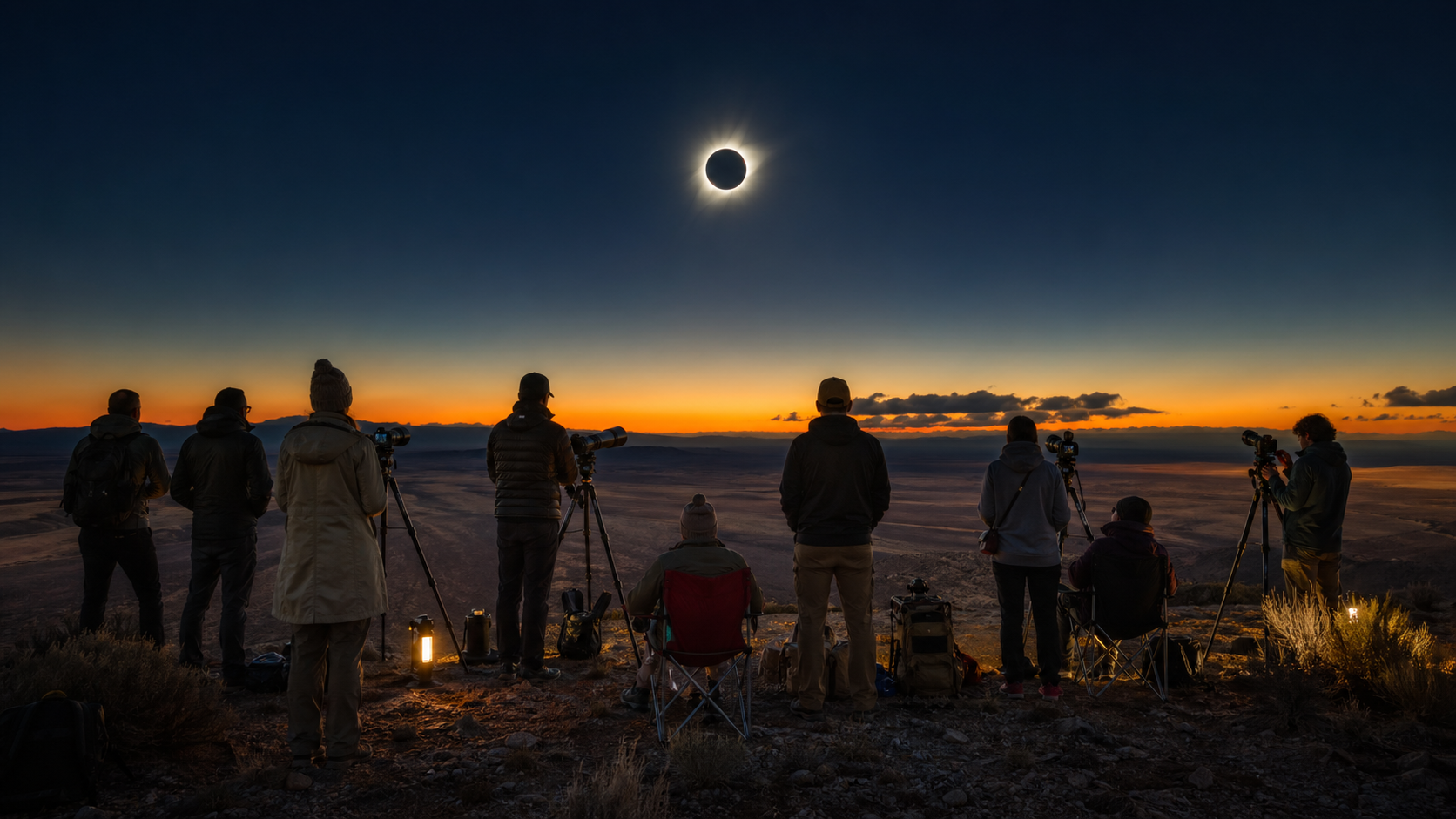
Eclipse chasers are people who travel to stand inside the Moon's shadow.
Some are scientists. Some are photographers. Some are families planning one unforgettable trip. Some have seen totality many times and still cross oceans for a few more minutes under a darkened Sun.
The habit has a modern name, but the impulse is old. Once people learned that eclipses could be predicted, the next question was obvious: where do I need to be?
From prediction to travel
For most of human history, eclipses were observed from wherever people happened to live. That changed as prediction improved.
In 1715, Edmond Halley used Newtonian astronomy to predict the path and timing of a solar eclipse over England with unusual precision for the time. Accurate path prediction made eclipse travel more practical. If you could know where totality would pass, you could choose a place in advance.
Travel still carried risk. In 1780, Harvard professor Samuel Williams led an expedition during the American Revolutionary War to observe a total eclipse. The group received permission to pass through enemy lines, but the predicted path was wrong enough that they ended up outside totality.
That failure captures a lasting rule of eclipse chasing: location matters, and small errors can decide everything.
Victorian eclipse expeditions
By the 19th century, eclipse chasing had become part scientific expedition, part travel story.
Governments, observatories, scientific societies, and wealthy amateurs sent equipment around the world. Expeditions carried telescopes, spectroscopes, cameras, timing instruments, portable darkrooms, and everything needed to build temporary observatories.
The trips were not only about seeing totality. They were about measuring the corona, photographing the eclipse, studying spectra, refining solar physics, and reporting the adventure to the public.
This is when eclipse travel began to look recognizably modern. There were itineraries, logistics, published accounts, specialized instruments, and the constant worry that clouds could erase years of planning in a few minutes.
The rise of totality tourism
Eclipse chasing eventually moved beyond professional science. Writers, amateur astronomers, photographers, and travelers began to treat totality as a destination.
Mabel Loomis Todd, an American writer and eclipse traveler in the late 19th century, helped popularize the experience through lectures and writing. Her travels showed that eclipse expeditions could be cultural events as well as scientific ones.
In the 20th century, travel technology widened the possibilities. Ships carried observers to remote ocean paths. Aircraft chased the shadow. In 1972, a dedicated eclipse cruise aboard the Olympia took hundreds of passengers into the Atlantic path of totality. In 1973, Concorde was used to follow an eclipse from high altitude, extending the observing time for scientists.
Today, eclipse chasing includes commercial tours, independent road trips, camera crews, school groups, app-guided planning, and last-minute weather moves.
Why people keep chasing totality
The practical reason is simple: totality is rare at any one location. A total solar eclipse happens somewhere on Earth roughly every 18 months, but the path is narrow. Your home may wait centuries between total eclipses.
The emotional reason is harder to explain until you see one. Totality is not just a dimmer daylight. The temperature can drop. The horizon can glow in every direction. The corona appears around a black Moon. People who expected a visual event often describe it as physical and communal.
That is why many first-time observers become chasers. They realize that a total eclipse is not interchangeable with a partial eclipse, a photograph, or a livestream.
Modern planning is better, but not effortless
Today's chasers have tools that earlier observers would envy: detailed maps, weather models, satellite imagery, local contact times, mobile alerts, and GPS.
Even so, the old problems remain. You still need to be inside the path. You still need a clear enough sky. You still need safe solar viewing during the partial phases. And you still need to know exactly when totality begins and ends.
That is why eclipse chasing rewards both flexibility and precision. The shadow does not wait.
Sources and related guides
- Smithsonian Magazine's A Brief History of Eclipse Chasers traces eclipse travel from early prediction to modern trips.
- JSTOR Daily's Solar Eclipse Tourism: The Victorians Were the Pioneers summarizes the Victorian expedition culture behind eclipse tourism.
- NASA's History of Eclipses gives wider historical context for eclipse science and public observation.
- Related SolarWatch guides: the path of totality, the August 12, 2026 eclipse guide, solar eclipse safety, and eclipse contact times.
See it in SolarWatch
SolarWatch is built for the practical side of eclipse chasing: compare places, inspect the path, check local contact times, and set reminders before the Moon's shadow arrives.