 Engin Kurutepe
Civil twilight is the period when the Sun is below the horizon but no more than 6° below it. Evening civil twilight runs from sunset to civil dusk; morning civil twilight runs from civil dawn to sunrise. There is usually enough light to work outside without artificial light, and it's the boundary many aviation rules use to define night.
The three twilights
NOAA's solar glossary defines each twilight by how far the Sun is below the horizon:
| Twilight | Sun below the horizon | What it's like on a clear day |
|---|---|---|
| Civil | 0° to 6° | Outdoor tasks are possible without lights; the brightest stars and planets appear |
| Nautical | 6° to 12° | The horizon is still visible at sea, but most tasks need light |
| Astronomical | 12° to 18° | The sky is nearly dark; faint objects are still washed out |
Cloud, smoke and terrain make it darker than these figures suggest. The definitions describe the Sun's position, not how bright it is where you stand.
How long civil twilight lasts
The Sun sets at a steeper angle near the equator and at a shallower angle further from it, so twilight lasts longer at higher latitudes. Calculated for 2026:
| Place | 20 March | 21 June | 21 December |
|---|---|---|---|
| Quito (0.2° S) | 21 min | 23 min | 23 min |
| New York (40.7° N) | 27 min | 33 min | 31 min |
| Berlin (52.5° N) | 34 min | 50 min | 42 min |
| Edinburgh (56.0° N) | 37 min | 62 min | 47 min |
| Fairbanks (64.8° N) | 49 min | all night | 86 min |
In Fairbanks around the June solstice the Sun never sinks 6° below the horizon, so evening civil twilight runs straight into morning civil twilight. A rule that starts at "end of civil twilight" doesn't apply on those nights.
Civil twilight in aviation
In the United States, 14 CFR 1.1 defines night as the time between the end of evening civil twilight and the beginning of morning civil twilight, as published in the Air Almanac and converted to local time. In the EU, the Standardised European Rules of the Air (Implementing Regulation (EU) No 923/2012) define night with the same civil-twilight boundary, with civil twilight ending or beginning when the centre of the Sun's disc is 6° below the horizon. Some rules let national authorities prescribe a different period.
Not every rule uses that boundary. The FAA's night currency requirement in 14 CFR 61.57(b) counts takeoffs and landings made between one hour after sunset and one hour before sunrise. When you plan a flight or a logbook entry, check which definition the rule in question uses. Use official publications or your flight planning tools for operational decisions; an app is a planning aid.
If you fly across a region, twilight times shift with both longitude and latitude. Two airports a few hundred kilometres apart north to south can differ by many minutes.
Cycling, running and outdoor work
Road lighting laws are usually based on sunset and sunrise, or on a fixed offset from them, rather than on civil twilight. Check the rules where you ride. Even so, civil dusk is a useful personal limit: after it, drivers see you mainly by your lights and reflectors.
For outdoor work, such as building sites, farm jobs or field surveys, civil dusk is a realistic end time for tasks that need natural light. On overcast days, plan to finish earlier.
Look it up in SolarWatch
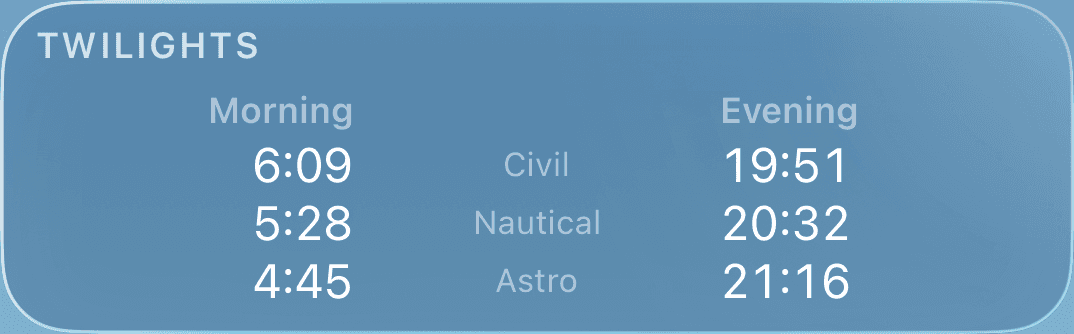
- Add the Twilights tile to see morning and evening civil, nautical and astronomical twilight for the selected place and date.
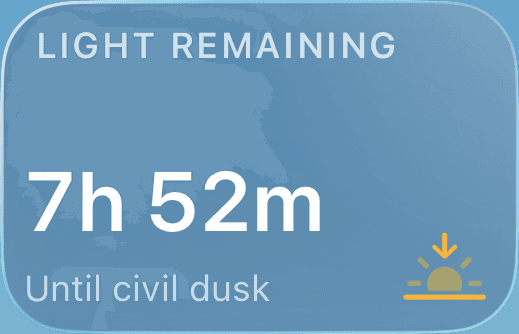
- Add Light Remaining for a countdown to civil dusk. After dusk it shows that it's dark and when the next dawn comes.
- Add Classic Data for a table of all the day's solar times. Tap the table to switch between clock times and time remaining.
- Save each place you need, such as your home airfield and regular destinations, as a favorite, then use the date button to check a future day.
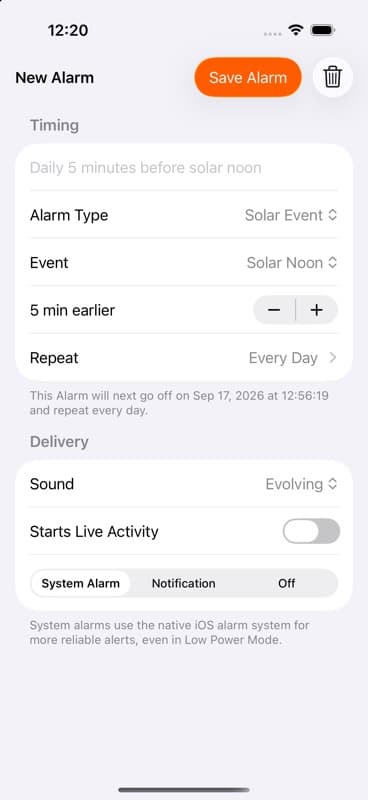
- Set a solar alarm (Gold) for civil dawn or civil dusk, with an offset if you need time to get ready.
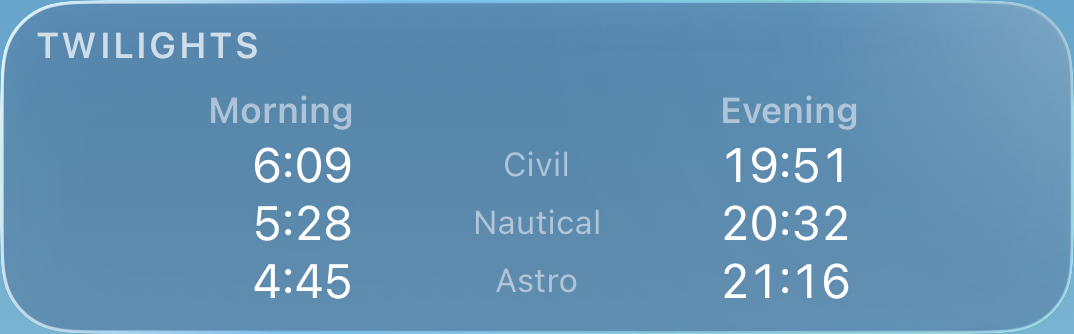
Twilights · Light Remaining · Classic Data · Solar alarms for your routine