 Engin Kurutepe
Day length doesn't change at a steady rate. Around the March and September equinoxes it changes fastest, by several minutes a day at mid and high latitudes. Near the June and December solstices the change slows to a few seconds a day before it reverses. How large the daily change gets depends mostly on how far you are from the equator.
How fast day length changes where you live
The table below shows the time from sunrise to sunset, and how much it changed from the day before, for five places in 2026. The values were calculated with the standard sunrise and sunset definition (the top of the Sun's disc on an open horizon, allowing for atmospheric refraction).
| Place | Daily change, 20 March | Daylight, 21 June | Daylight, 21 December |
|---|---|---|---|
| Quito (0.2° S) | about 1 second | 12 h 7 min | 12 h 8 min |
| New York (40.7° N) | +2 min 43 s | 15 h 6 min | 9 h 15 min |
| Berlin (52.5° N) | +4 min 7 s | 16 h 50 min | 7 h 39 min |
| Edinburgh (56.0° N) | +4 min 41 s | 17 h 36 min | 6 h 57 min |
| Fairbanks (64.8° N) | +6 min 44 s | 21 h 50 min | 3 h 41 min |
Near the equator day length hardly changes all year. In Fairbanks, the days in March grow by almost seven minutes, so a week adds about three quarters of an hour. In late September the same places lose daylight just as quickly. In the Southern Hemisphere the pattern is reversed: days lengthen from June to December.
Why the change is uneven
Earth's axis is tilted about 23.4° to its orbit. Over a year, the latitude where the Sun is overhead at noon moves north to the Tropic of Cancer and back south to the Tropic of Capricorn. That movement is fastest at the equinoxes and pauses at the solstices, so the change in day length follows a smooth wave rather than a straight line. Close to a solstice you'll see changes of only a few seconds. In Berlin the 21 December figure is 9 seconds shorter than the day before; a few days later the days start growing again.
Sunrise and sunset don't move together
The shortest day isn't the day with the earliest sunset. At mid-northern latitudes the earliest sunset arrives in early to mid-December and the latest sunrise in early January. Solar noon drifts later on the clock during December, so evenings start to lengthen before mornings do. If you count the evening light gained after work, you'll notice the change sooner than the total day length suggests.
Daylight saving time moves the clock, not the Sun. A one-hour jump in sunset time on the night clocks change isn't extra daylight; compare total day length to see the real trend.
Check your own numbers in SolarWatch
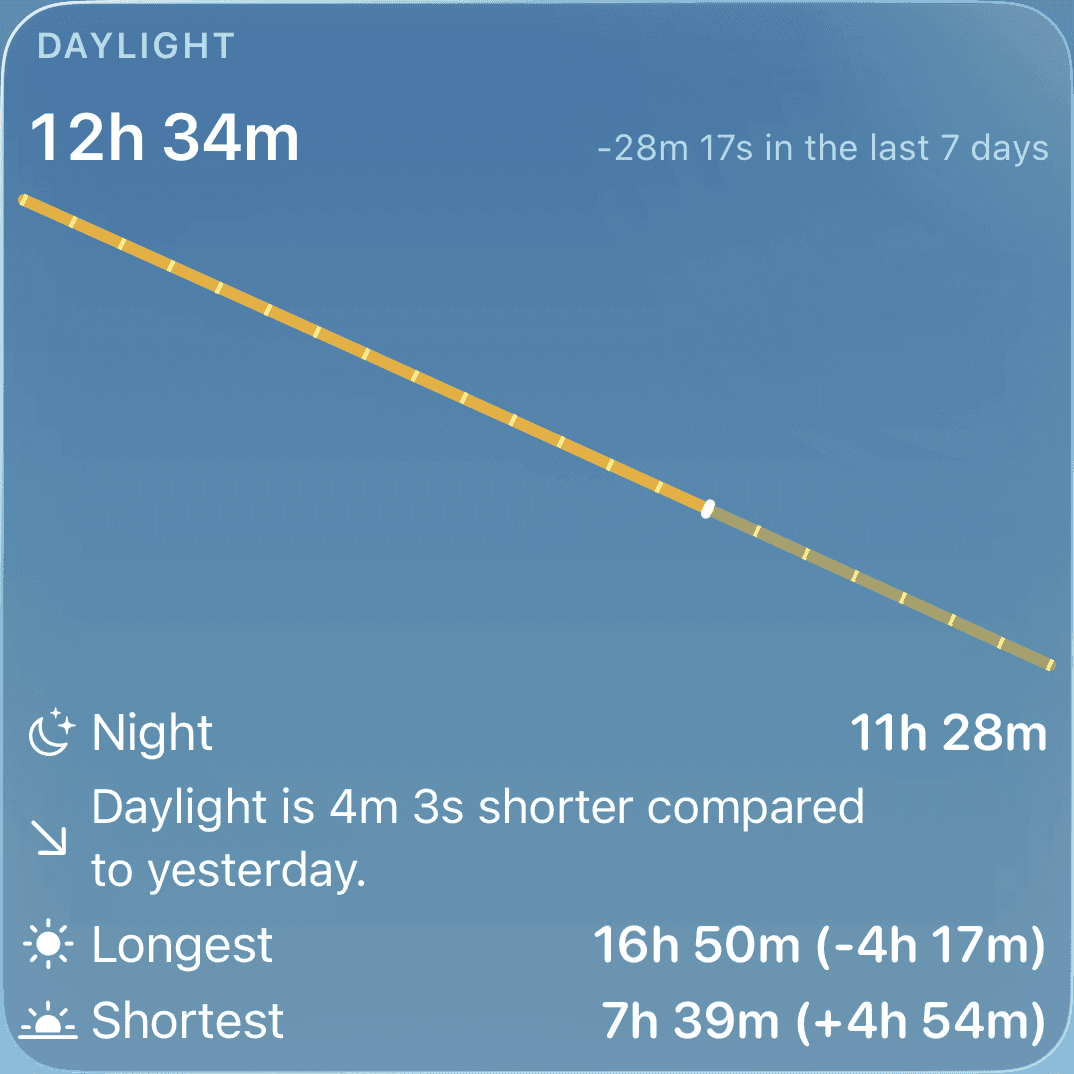
- Add the Daylight tile to your dashboard. The Medium size shows today's daylight with a small chart and the change over the past seven days.
- Resize it to Large to add a line saying how much longer or shorter today is than yesterday, together with the year's longest and shortest days and how far today is from each.
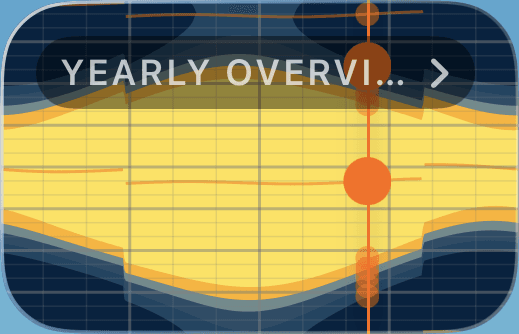
- Tap Yearly Overview to see how daylight and solar times change across the whole year for the selected place.
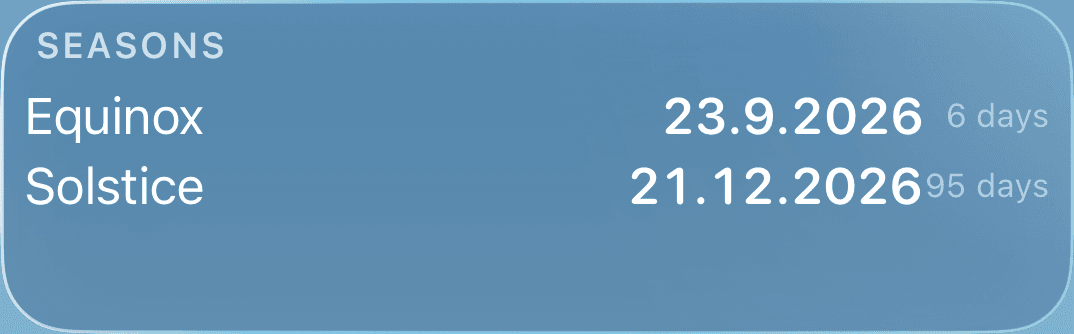
- Add Seasons to see the dates of the next equinox and solstice, where the turning points are.
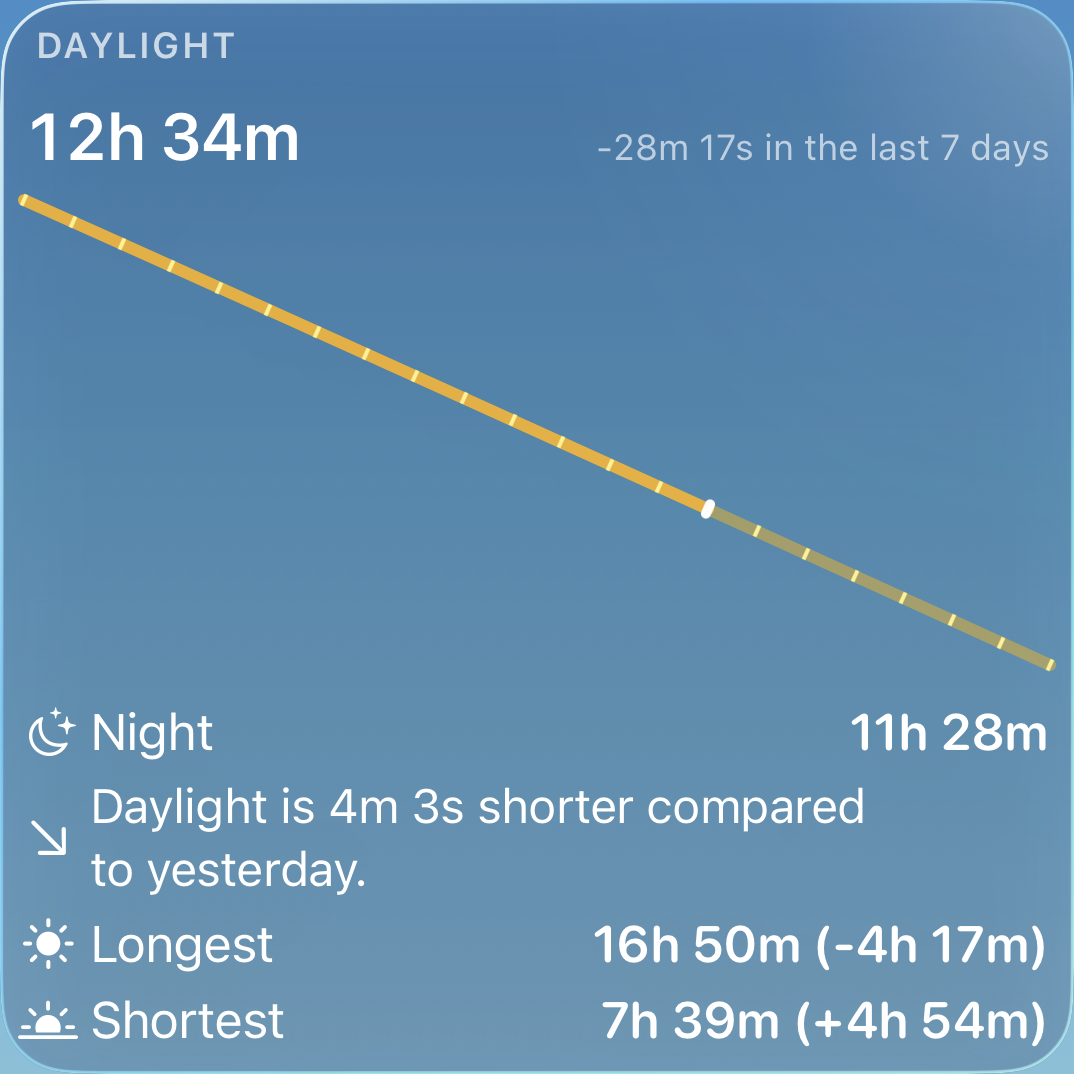
The tiles follow the place shown on the dashboard, so you can check a saved city as well as your current location. To see another date, use the date button, or turn on rotating the Solar Wheel to change the date in Settings → Main Screen.
Daylight tile · Yearly Overview · Seasons · Edit the dashboard
Ways to use the numbers
- Watch for the turning point. If dark winters get you down, the days after the December solstice change by seconds at first, then by minutes a day by February.
- Plan evening routines. A run, a ride home or a walk with the dog moves into darkness faster in October than in December. Compare the weekly change rather than a single day.
- Compare two places. Save the city you're moving to or travelling to and compare its yearly overview with home. The difference is largest in winter.
NOAA's solar calculator notes describe the sunrise and sunset calculations used by most daylight tables.