
 Engin Kurutepe
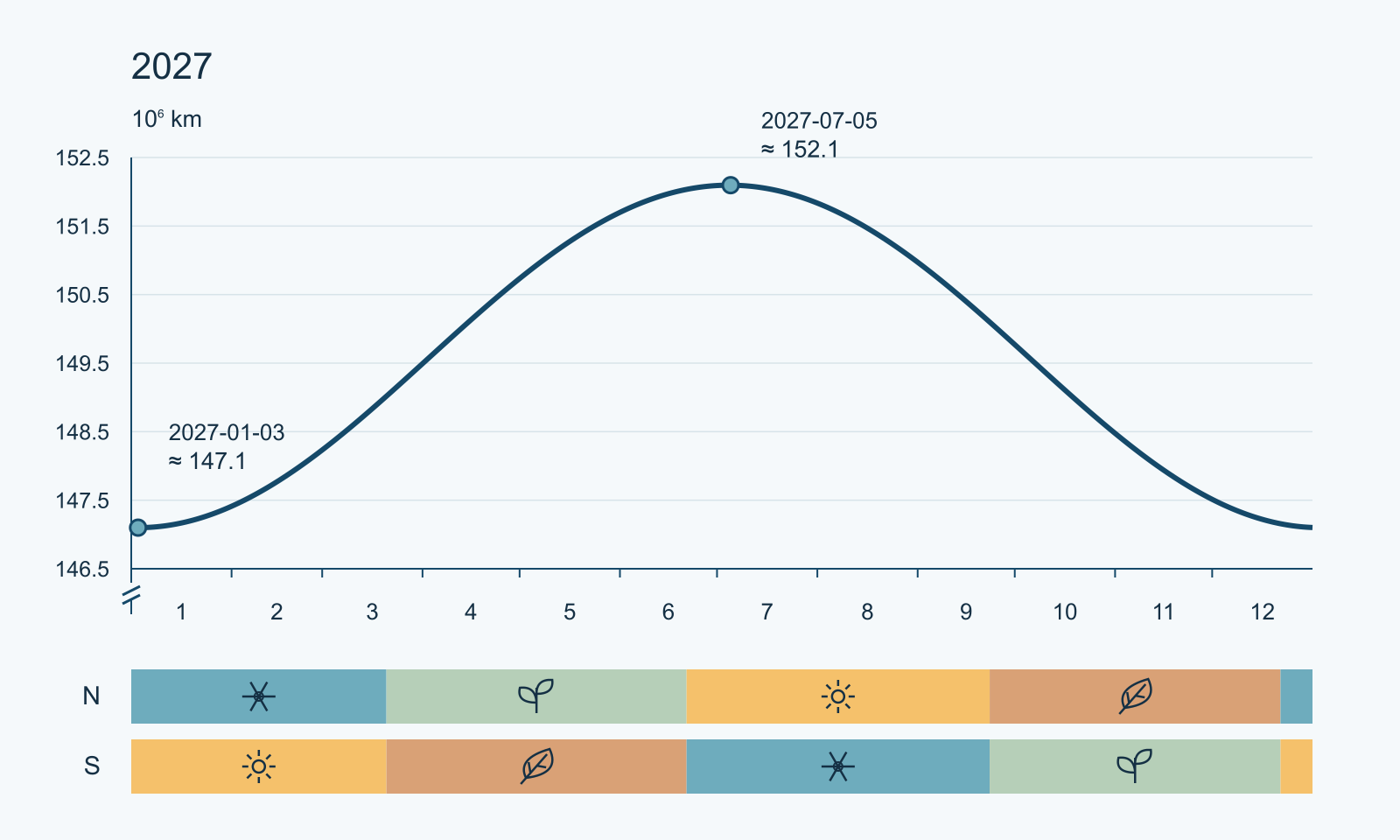
Earth is closest to the Sun in early January. That point in the orbit is called perihelion, and it falls in the middle of winter for everyone in the Northern Hemisphere. In early July, at aphelion, Earth is at its farthest, and Europe, North America and most of Asia are having summer.
So distance cannot be what makes summer warm. The seasons come from the tilt of Earth's axis, about 23.44 degrees. The changing distance has only a small effect, and it shows up mostly in the Southern Hemisphere.
A common mix-up
It feels logical: stand closer to a fire and you get warmer. Many people explain the seasons the same way. In the 1987 documentary *A Private Universe*, filmed at a Harvard graduation, most of the graduates and faculty asked about the seasons gave some version of the distance answer.
Two simple facts rule it out. First, the timing is wrong for the north, as you saw above. Second, the two hemispheres have opposite seasons at the same moment. When it is summer in Italy, it is winter in Argentina, yet both countries are the same distance from the Sun.
How small the distance change is
Earth's orbit is an ellipse, but only just. At perihelion Earth is about 147.1 million kilometers from the Sun. At aphelion it is about 152.1 million kilometers away. That is a change of a little over 3%.
Because sunlight spreads out with distance, the sunlight reaching the top of the atmosphere is about 7% stronger in January than in July. You can read the dates, times and numbers in our guide to perihelion and aphelion.
Seven percent is not nothing. But the tilt changes the sunlight reaching the ground in any one place by far more than that.
What the tilt does
Earth's axis keeps pointing in the same direction in space as Earth goes around the Sun. In June, the Northern Hemisphere leans toward the Sun. In December, it leans away. The Southern Hemisphere gets the opposite.
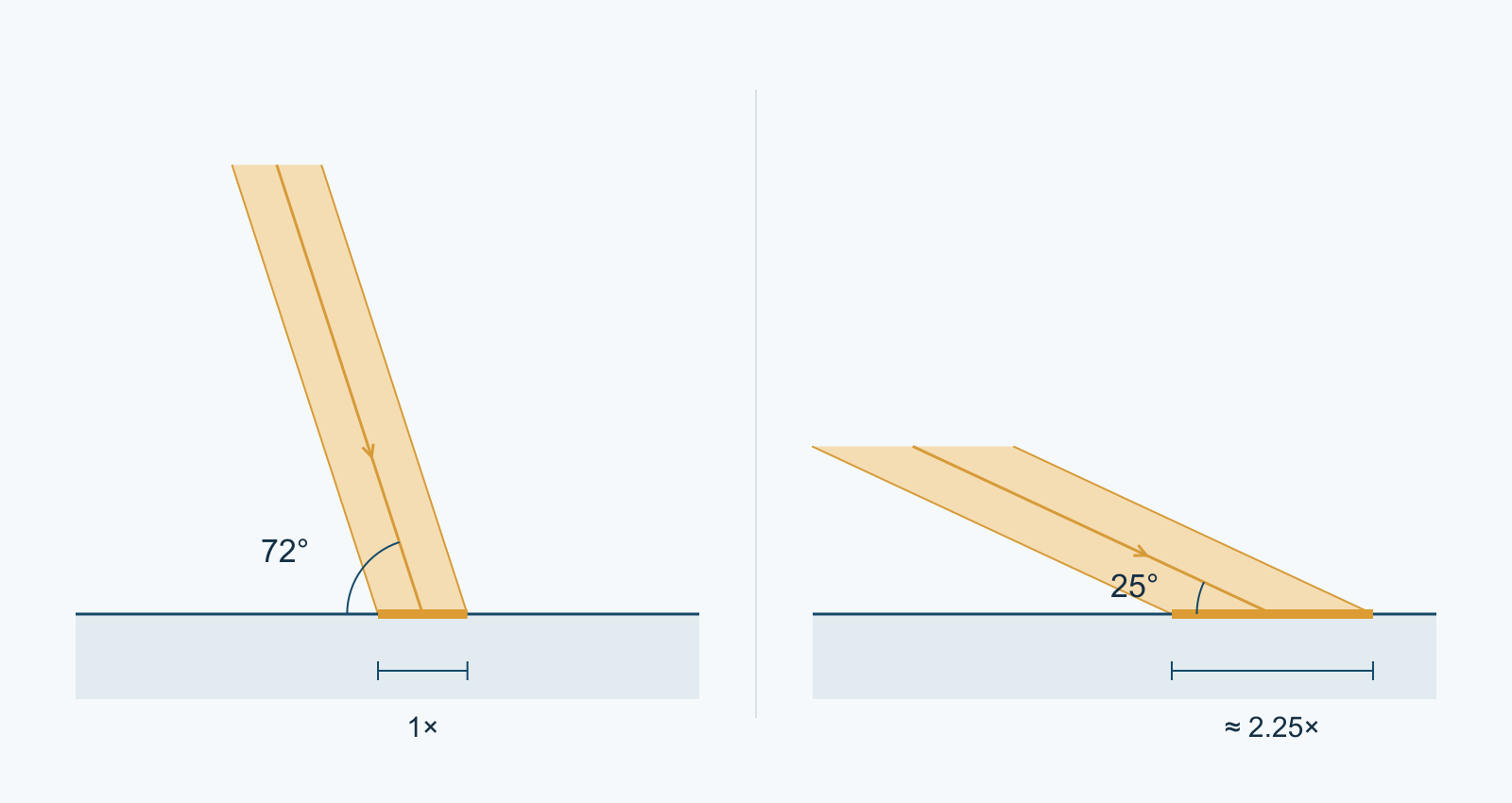
The lean changes how high the Sun climbs. When the Sun is high, its light hits the ground almost straight on and is concentrated on a small area. When it is low, the same beam is spread across a much larger area, like a flashlight held at a slant. Low sunlight also passes through more air before it reaches you.
It also changes how long the day lasts. In summer the Sun is above the horizon for many more hours, so the ground has more time to warm up and less night to cool down.
The table below compares Rome and Sydney at the two solstices. The last column is the total sunlight that reaches one square meter of flat ground over a full day, measured above the atmosphere so that clouds and haze do not get in the way.
| Place | Date | Distance to the Sun | Sun height at noon | Day length | Sunlight per day |
|---|---|---|---|---|---|
| Rome (42° N) | 21 June | 152.0 million km | 72° | 15 h 13 min | 11.6 kWh/m² |
| Rome (42° N) | 21 December | 147.2 million km | 25° | 9 h 07 min | 3.4 kWh/m² |
| Sydney (34° S) | 21 June | 152.0 million km | 33° | 9 h 53 min | 4.5 kWh/m² |
| Sydney (34° S) | 21 December | 147.2 million km | 80° | 14 h 24 min | 12.3 kWh/m² |
In June, Rome is about 3% farther from the Sun than in December, yet it gets more than three times as much sunlight per day. That is the tilt at work. Sydney shows the same pattern, flipped by six months.
Seen from space
NASA's DSCOVR spacecraft photographs the whole sunlit side of Earth from about 1.5 million kilometers away. Compare its pictures from June and December and you can see the tilt directly. Around the June solstice the Arctic is in full sunlight and Antarctica is out of view. In December it is the other way around.
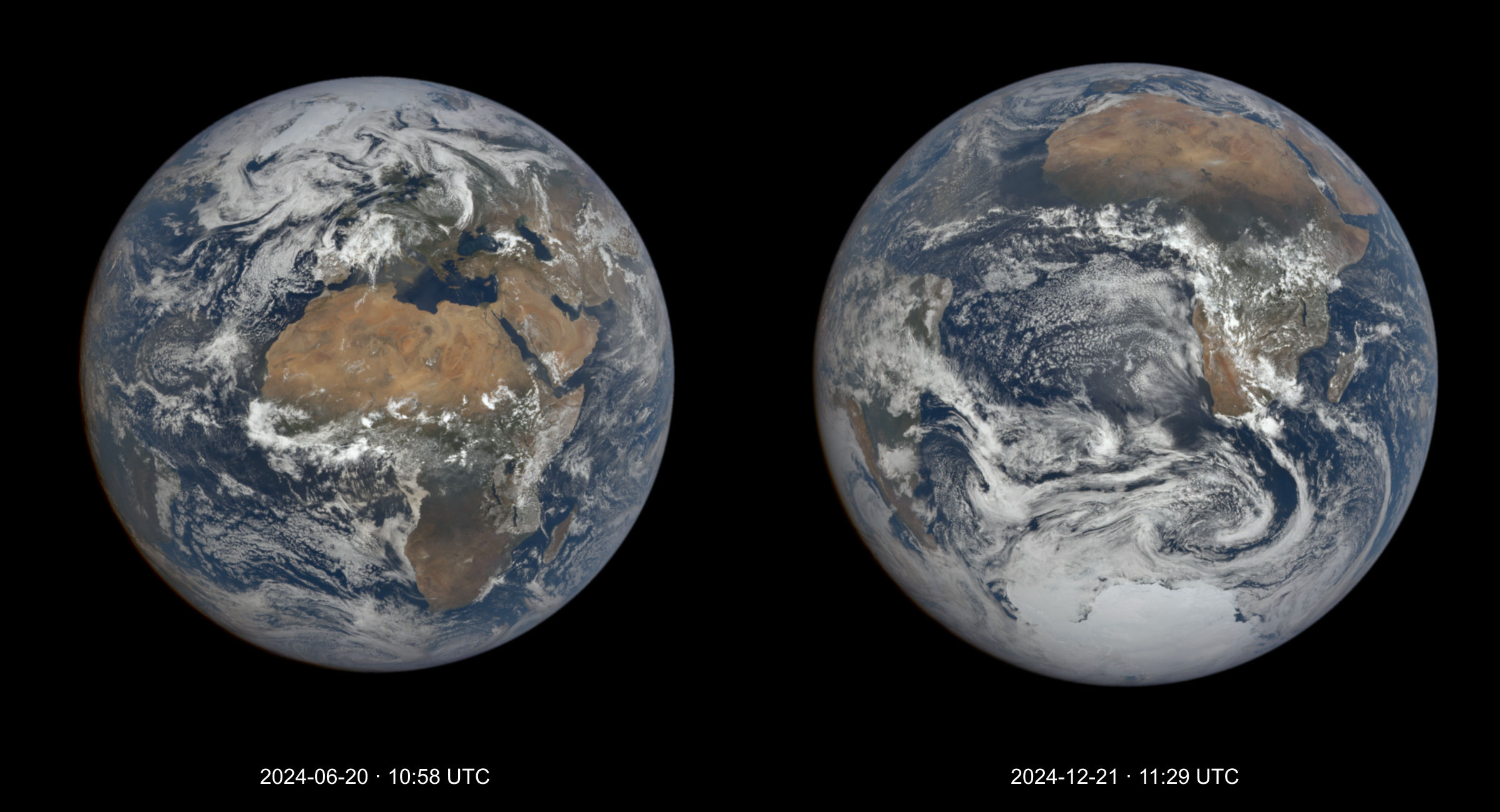
NASA EPIC Team · 2024-06-20 / 2024-12-21
Does the distance matter at all?
A little. The Southern Hemisphere has its summer near perihelion, so its summer sunlight is slightly stronger than the north's. In New Zealand, for example, the closer Sun adds about 7% to summer UV levels compared with northern sites at the same latitude. Cleaner air and thinner summer ozone add more on top of that.
Southern summers are not hotter overall, though. One reason is that Earth moves faster when it is near the Sun. The southern warm half of the year, from the September equinox to the March equinox, lasts about 179 days. The northern one lasts about 186 days. Over each half-year, the shorter time near the Sun exactly balances the stronger sunlight, so both hemispheres receive the same total.
The other reason is that the Southern Hemisphere is mostly ocean. Water heats and cools slowly, which keeps southern summers mild. The large land areas of the north warm up quickly in July. That is why Earth as a whole is a few degrees warmer in July, at aphelion, than in January.
It will not always be this way
Perihelion falling in January is a coincidence of our time. The direction of Earth's axis slowly wobbles, and the orbit itself turns, so the date of perihelion drifts through the calendar. Around the year 1250 it fell close to the December solstice. In roughly 10,000 years it will fall in northern summer, and the north will then be closest to the Sun in June.
Even then, the tilt will still decide which months are summer. The distance will only make northern summers a little stronger and southern ones a little weaker.
Sources and related guides
- The US Naval Observatory lists dates of perihelion, aphelion, equinoxes and solstices.
- NASA Space Place explains what causes the seasons.
- NASA's EPIC image archive has daily full-disc photos of Earth from the DSCOVR spacecraft.
- NIWA describes why UV levels are so high in New Zealand, including the effect of the closer Sun.
- The Harvard-Smithsonian Center for Astrophysics has background on *A Private Universe*.
- Related SolarWatch guides: perihelion and aphelion and how much daylight you gain each day.
See it in SolarWatch
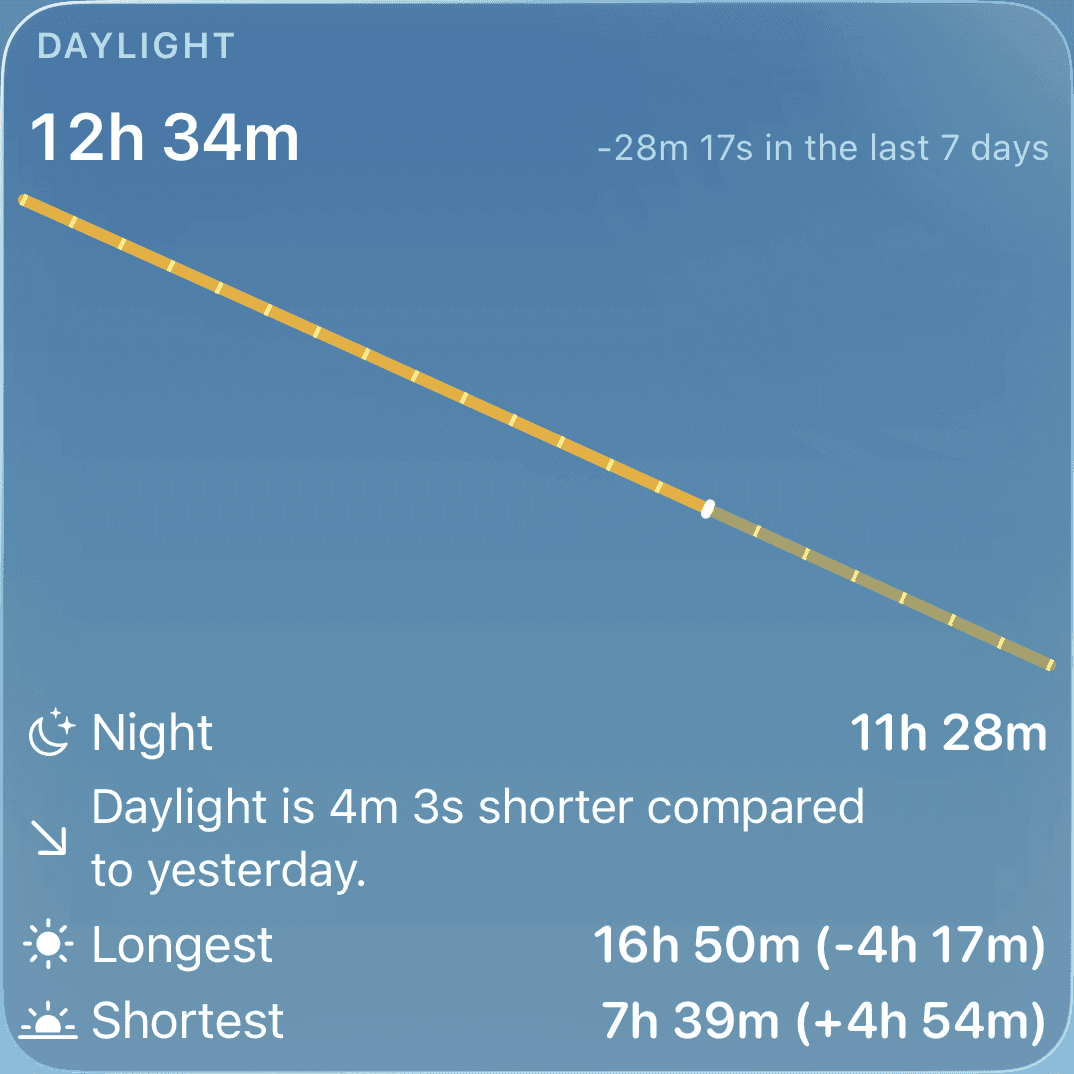
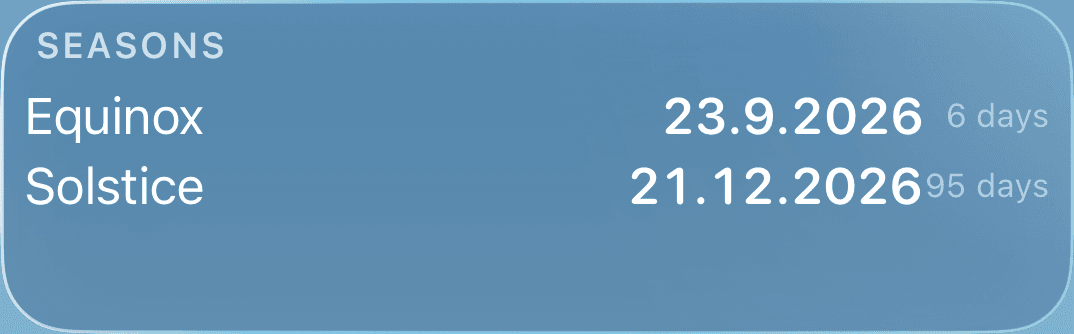
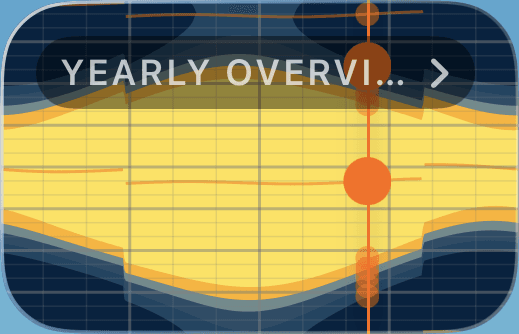
The Seasons tile shows when the next equinox and solstice happen. The Daylight tile shows how long the Sun is up today where you are, and the Yearly Overview shows how sunrise, sunset and day length change over the year. Those curves follow the tilt of Earth's axis. The distance to the Sun barely shows up in them.
Keep reading
All guides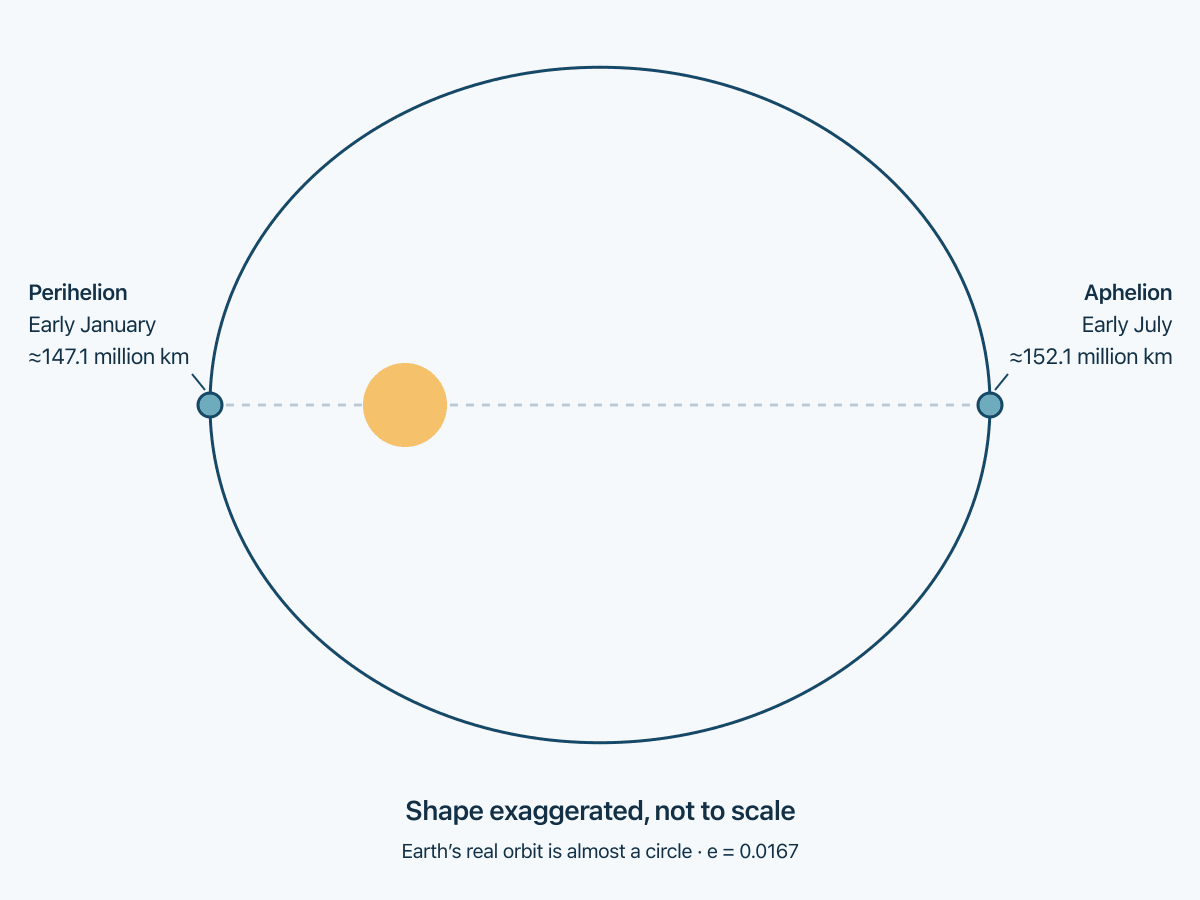
4 min read
Perihelion and Aphelion: When Earth Is Closest to the Sun
Earth is closest to the Sun in early January and farthest in early July. See the dates for the next few years and how much the distance changes sunlight.
4 min read
How to track how much daylight you gain or lose each day
See how many minutes of daylight you gain or lose each day, why the change is fastest at the equinoxes, and how latitude changes the numbers.
1 min read
Seasons
Seasons · SolarWatch
1 min read
Daylight
Daylight · SolarWatch
1 min read
Yearly Overview
Yearly Overview · SolarWatch