
 Engin Kurutepe
A solar panel collects the most direct sunlight when it faces the Sun squarely. For that, its tilt from horizontal should equal 90° minus the Sun's elevation, and it should point toward the Sun's compass direction (azimuth). With the Sun 30° above the horizon, tilt the panel to 60°. Small errors cost very little, so a panel you adjust by hand every so often gets close to what a motorised tracker would.
The angle that matters
PVEducation explains that the direct light reaching a panel falls with the cosine of the angle between the Sun's direction and the panel's face. A panel squarely facing the Sun has a tilt equal to the Sun's zenith angle (90° minus elevation) and the same azimuth as the Sun.
Elevation is the Sun's height above the horizon. Azimuth is its compass direction, measured clockwise from true north: east is 90°, south 180° and west 270°, as in NOAA's definitions.
| Sun's elevation | Panel tilt from horizontal |
|---|---|
| 15° | 75° (nearly upright) |
| 30° | 60° |
| 45° | 45° |
| 60° | 30° |
How much a few degrees costs
If the panel is off by a few degrees, the loss of direct light is tiny:
| Angle between panel and Sun | Direct light lost |
|---|---|
| 5° | 0.4% |
| 10° | 1.5% |
| 15° | 3.4% |
| 20° | 6.0% |
| 30° | 13.4% |
The loss grows quickly beyond about 20°. Adjusting the panel whenever it's around 10° off keeps the loss from the angle near 1–2%. That's why a few adjustments a day work well, and why you don't need to fiddle with the angle every few minutes. On cloudy days most light is diffuse and arrives from the whole sky, so the angle matters much less.
How the right angle changes through the year
The Sun's highest point each day changes a lot between seasons. Calculated for 2026:
| Place | 21 June | 21 December |
|---|---|---|
| Berlin | 61° / 29° | 14° / 76° |
| Graz | 66° / 24° | 20° / 70° |
| New York | 73° / 17° | 26° / 64° |
Each cell shows the highest Sun of the day / the best tilt for that midday.
A panel that's well angled for a June midday is more than 45° off in December. Even if you only adjust it a few times a year, changing the tilt with the seasons helps.
Fixed direction, adjustable tilt
Many balcony and portable panels can tilt but can't turn to follow the Sun. If your panel faces a fixed direction, the best tilt is 90° minus the elevation only when the Sun is roughly in front of it. In the morning and evening the Sun moves round to the side, and a south-facing panel gets less direct light whatever its tilt. In that case, set the tilt for the hours around midday, when most of the energy arrives.
If your mount can rotate as well, follow the azimuth too: turn the panel east in the morning and west in the afternoon.
Get reminded when to adjust it
You don't have to keep checking the Sun. SolarWatch can tell you its current elevation and azimuth, and can alert you when it reaches a height you choose.
- To see the Sun's current elevation and direction, show sun position in the centre or outer ring of the Solar Wheel (Settings → Main Screen). On Apple Watch, a sun elevation or direction complication keeps it on your wrist.
- Create a solar alarm (Gold), choose Elevation, and set a height, for example 20°, rising.
- Add more alarms in steps for the morning: 30° and 40° rising, then the same heights setting in the afternoon. Each one is a reminder to change the tilt.
- If you rotate the panel as well, use Azimuth alarms for the compass directions where you want to turn it.
- Choose Notification delivery, with a quiet sound or None, if you'd rather not hear a full alarm for each step.
Solar alarms use your current location, which suits a panel at home. Not every height is reached every day: in Berlin in December the Sun never climbs above 14°, and the editor shows when a height won't be reached.
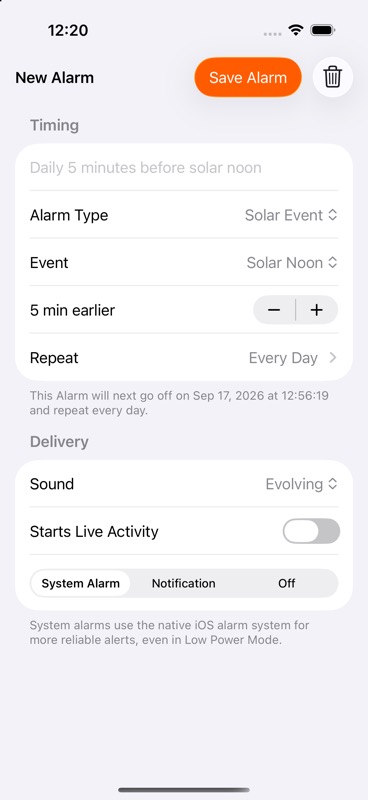
Timing options for alarms · Solar Wheel · Find when the sun reaches your home or garden
Before you move a balcony panel, check that the mount is secure in your adjusted position, especially in wind.
Keep reading
All guides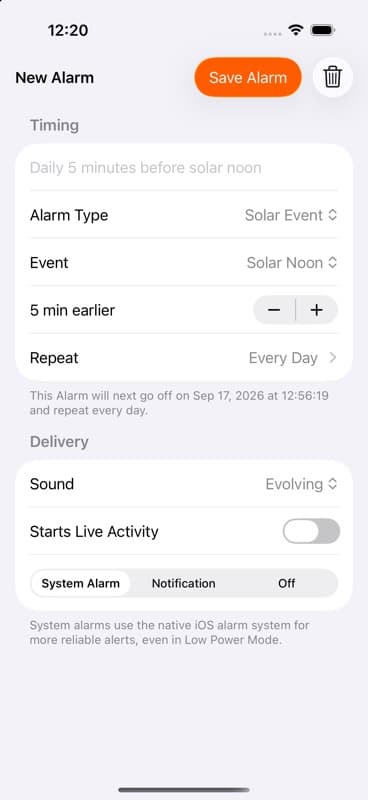
1 min read
Timing options
Timing options · SolarWatch
1 min read
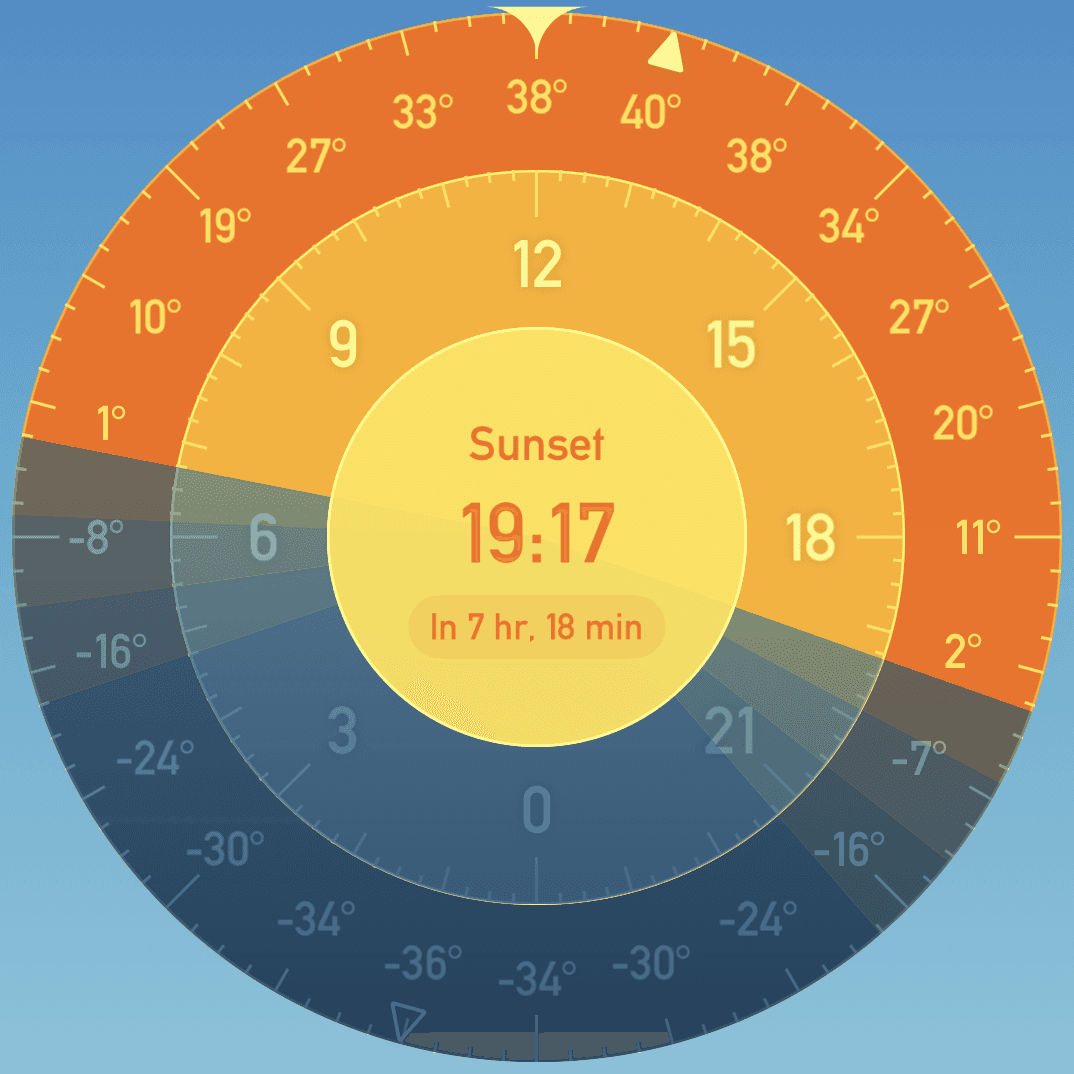
Solar Wheel
Solar Wheel · SolarWatch
3 min read
How to find out when the sun reaches your home or garden
Find which hours a window, balcony or garden bed gets direct sun, and how that changes between summer and winter, using the sun's path, shadows and the real horizon.