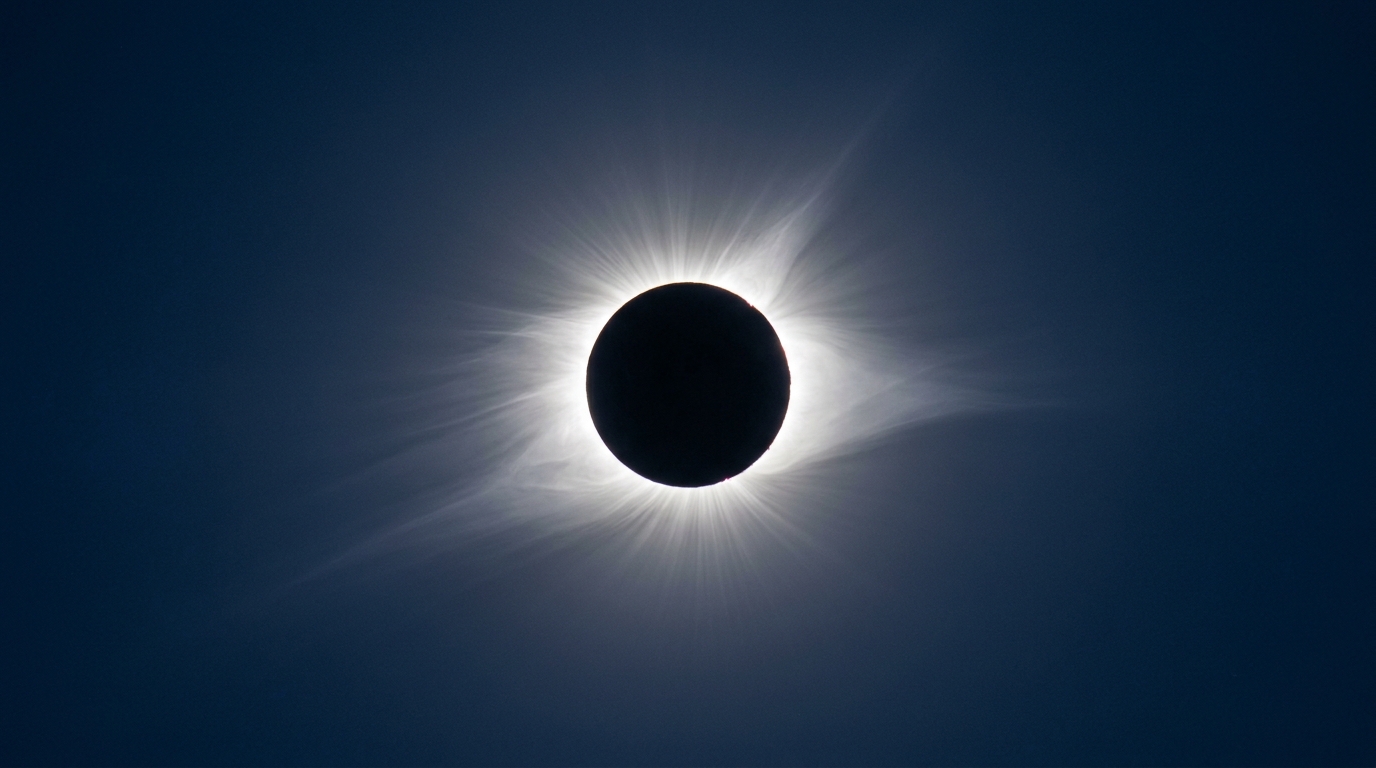
A solar eclipse is a global event with a very local view. Before choosing a destination, check whether the exact place you plan to stand sees a partial eclipse, an annular eclipse or totality. A nearby town can have a different experience.
Choose the experience first
During a total eclipse, the Moon covers the Sun's bright face completely for observers inside a narrow path. An annular eclipse leaves a bright ring; a partial eclipse leaves some of the Sun visible. A hybrid eclipse is total along some parts of its path and annular along others. It does not mean one observer sees a sequence of all types.
Use the eclipse types guide to understand the differences. High obscuration, even 99%, is not totality and does not create a safe unprotected viewing interval.
Check your exact location
Compare the local beginning, maximum and end times. Inside a totality path, also check when full coverage starts and finishes: those times vary with location. Near the edge, totality can be much shorter than on the centerline. The contact-time guide explains the labels.
Check the Sun's altitude and direction at maximum, then inspect the real horizon. A hill, tree or building can block a low Sun even under clear skies. Choose a legal, accessible spot with space to observe, and arrive early. Have an alternative location, but account for traffic and access before changing plans for a weather forecast.
Protect eyes and equipment
For direct viewing whenever any bright part of the Sun remains visible, use undamaged solar viewers that comply with ISO 12312-2 from a reputable supplier. Ordinary sunglasses are insufficient. Never look through unfiltered binoculars, telescopes or a camera viewfinder, even while wearing eclipse glasses. Seek expert advice about suitable front-mounted filters for optical equipment.
Unaided viewing is possible only during full totality, inside the totality path. Restore protection before bright sunlight returns; beads and the diamond ring contain exposed sunlight. Partial and annular eclipses have no unprotected viewing interval. For a first eclipse, a pinhole projection or simple observation plan is often more useful than a complicated photographic sequence. Read the viewing safety guide and AAS safety guidance.
Upcoming events
As of October 2026, the next annular eclipse is February 6, 2027, and the next total eclipse is August 2, 2027. The latter's totality path includes southern Spain and parts of North Africa and the Middle East. These regions describe the path broadly; check the exact location rather than assuming an entire country sees totality. NASA's upcoming eclipse list gives event details.
The August 12, 2026 article remains a reference for that past event.
Put the plan together
In SolarWatch, browse the eclipse catalog, open an event's map and select your observing location to compare local times and Sun angle. Use the information to prepare your visit, then recheck weather, access and equipment. A calculated time or forecast is planning information, not a substitute for the viewing-safety rules.