
 Engin Kurutepe
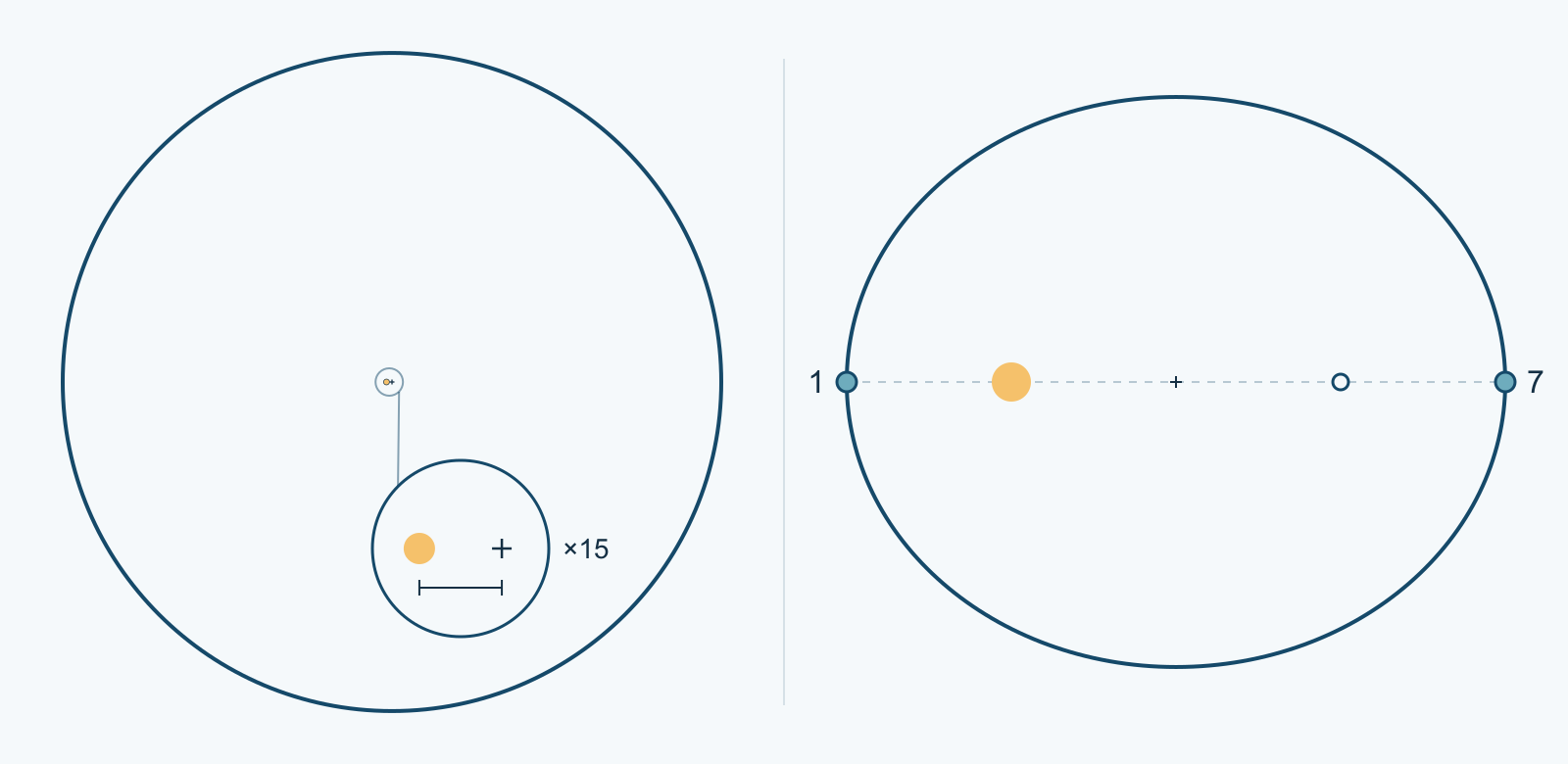
Earth travels around the Sun on an elliptical orbit, a slightly stretched loop rather than a perfect circle. The stretch is tiny. Drawn to scale, Earth's orbit looks exactly like a circle, and you would need a very fine ruler to find the difference.
What you can see in a true-scale drawing is that the Sun is not in the middle. It sits about 2.5 million kilometers to one side. That offset, more than the shape itself, is why Earth is closer to the Sun in January than in July.
What an ellipse is
An ellipse is a closed curve with two special points inside it called foci (singular: focus). For every point on the curve, the distances to the two foci add up to the same total.
You can draw one with two pins, a loop of string and a pencil. Put the pins in a board, place the string around them, pull it tight with the pencil and go around. If the pins are close together, you get something very close to a circle. If they are far apart, you get a long, thin oval.
In a planet's orbit, the Sun sits at one focus. The other focus is an empty point in space.
Eccentricity in plain words
Astronomers describe how stretched an orbit is with a number called eccentricity. It runs from 0 for a perfect circle to just under 1 for a very long, thin ellipse.
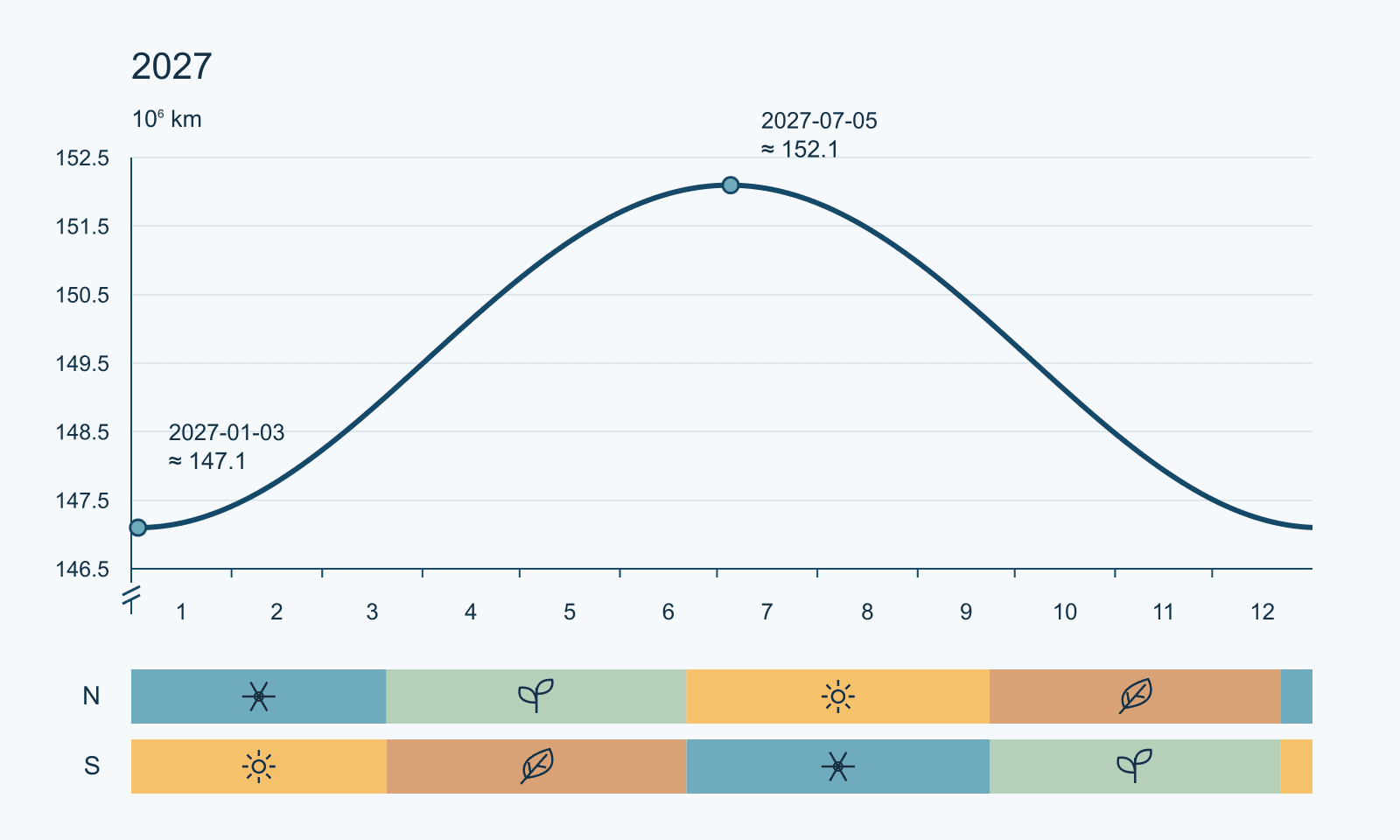
Earth's eccentricity is about 0.0167. You can work it out from two distances you may already know. At perihelion, Earth is about 147.1 million kilometers from the Sun. At aphelion, it is about 152.1 million kilometers away. Divide the difference by the sum: 5.0 ÷ 299.2 ≈ 0.0167.
The number also tells you how far the Sun is from the center of the orbit. Multiply it by the average distance, about 149.6 million kilometers, and you get about 2.5 million kilometers.
| Object | Eccentricity | What its orbit looks like |
|---|---|---|
| Venus | 0.007 | Almost a perfect circle |
| Earth | 0.017 | A circle to the eye, Sun visibly off-center |
| The Moon (around Earth) | 0.055 | Still very round |
| Mars | 0.093 | Slightly oval if you look closely |
| Mercury | 0.206 | Clearly oval |
| Halley's Comet | 0.967 | A long, thin loop |
How close to a circle is it?
Draw Earth's orbit 20 centimeters across, and the long and short axes of the ellipse would differ by about 0.03 millimeters, thinner than a pencil line. In real space that is a difference of about 42,000 kilometers out of almost 300 million.
The Sun, though, would sit about 1.7 millimeters from the center of the drawing. You could just see that. So Earth's orbit is a nearly perfect circle that is not quite centered on the Sun.
Most diagrams, including the one on our perihelion and aphelion page, stretch the shape so you can see where the closest and farthest points are. That is useful, but it can leave the impression that the orbit is an egg shape. It is not.
Kepler's three laws
In the early 1600s, Johannes Kepler worked through years of careful observations of Mars made by the Danish astronomer Tycho Brahe. Mars has one of the more oval orbits among the planets, and the numbers would not fit a circle. Kepler ended up with three rules that hold for every planet, including Earth.
1. Orbits are ellipses with the Sun at one focus. This is the first law, published in 1609. It replaced the old idea that planets move in perfect circles.
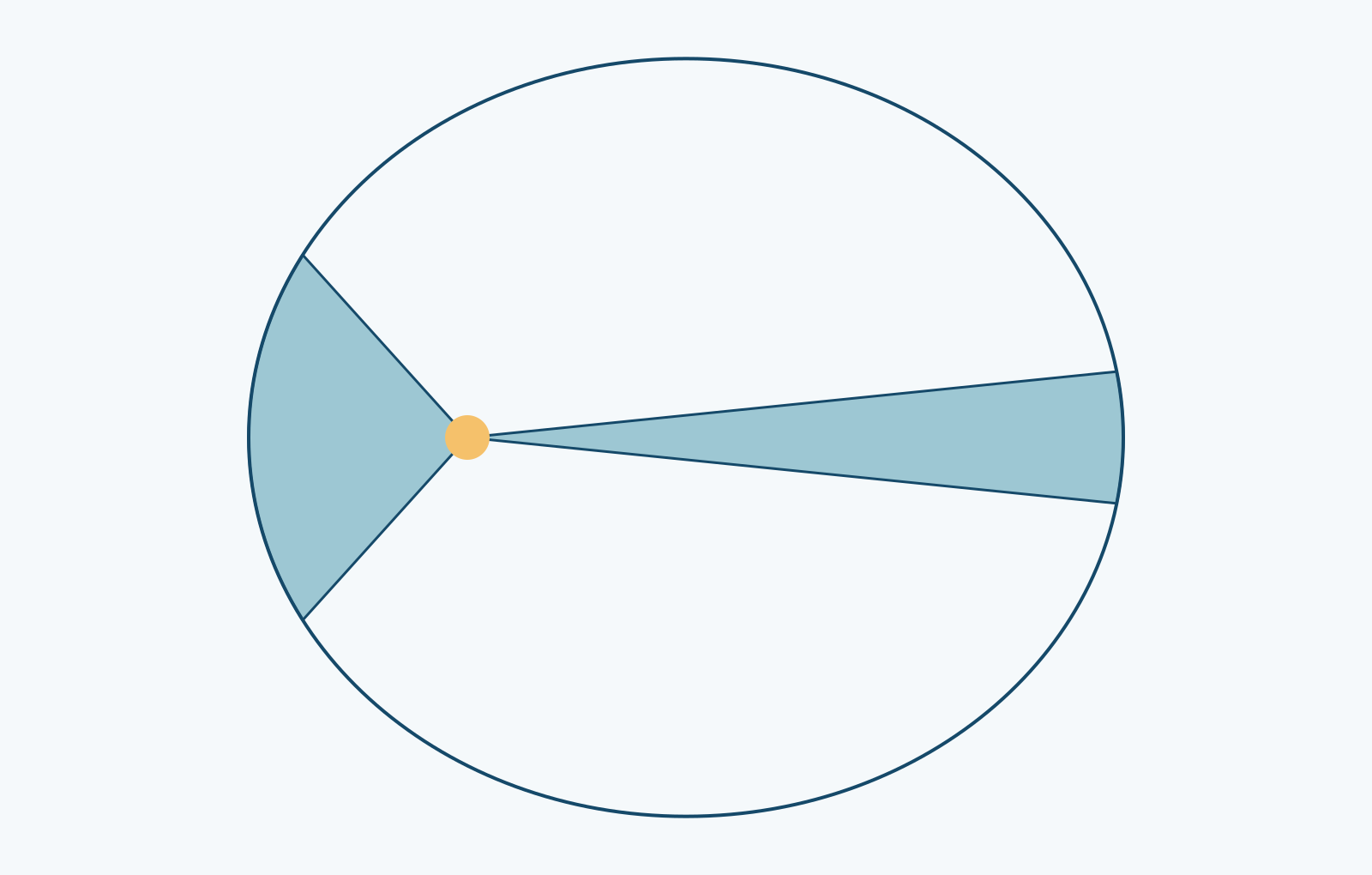
2. A planet sweeps out equal areas in equal times. Picture a line from the Sun to Earth. As Earth moves, the line sweeps across the space inside the orbit. Over any month, it covers the same area. Near the Sun the line is shorter, so Earth has to move faster to cover the same area. Earth's speed ranges from about 30.3 kilometers per second at perihelion to about 29.3 kilometers per second at aphelion.
3. Planets farther out take much longer to go around. The square of a planet's orbital period is proportional to the cube of its average distance from the Sun. Mars is about 1.52 times as far from the Sun as Earth. Cube that, take the square root, and you get about 1.88, so a year on Mars lasts about 1.88 Earth years, or 687 days.
Isaac Newton later showed that all three laws follow from his law of gravity. Every planet and comet circling the Sun obeys them.
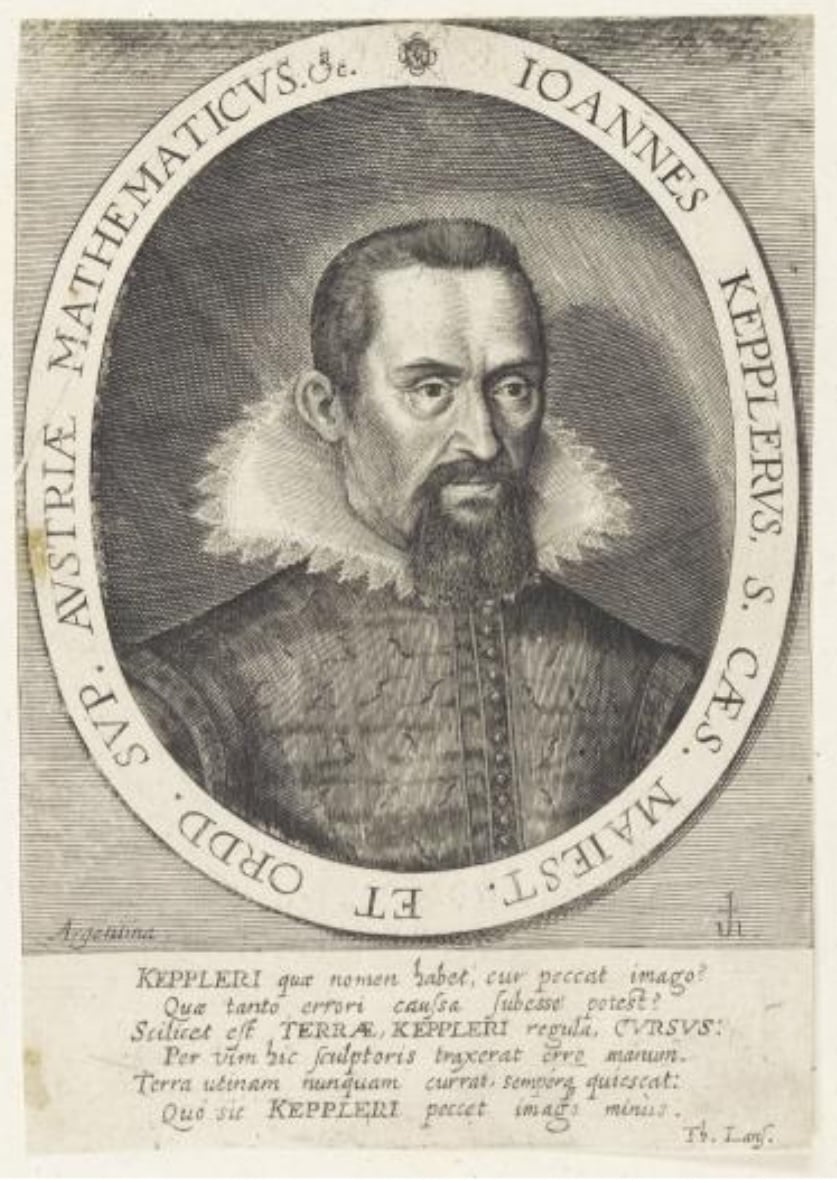
Jacob van der Heyden · Public domain

Why Earth's orbit is so round
The planets formed about 4.6 billion years ago from a flat disc of gas and dust circling the young Sun. Material in that disc moved on nearly circular paths, and friction with the gas and countless small collisions smoothed out any stretched orbits. Earth inherited a nearly circular orbit from that disc.
The orbit is not fixed, though. The pull of Jupiter, Saturn and the other planets slowly changes its shape. Over cycles of roughly 100,000 years, Earth's eccentricity varies between about 0.003 and 0.058. Today it is fairly low and slowly getting smaller. These long cycles are one of the factors behind the ice ages.
What the shape changes for you
The elliptical orbit has a few small effects you can notice in a calendar:
- Sunlight is about 7% stronger in early January than in early July. The tilt of Earth's axis still decides the seasons. Our guide on why Earth is closest to the Sun in northern winter explains why.
- The seasons are not equally long. Because Earth moves more slowly near aphelion, northern summer (June solstice to September equinox) lasts about 93.7 days, and northern winter (December solstice to March equinox) about 89.0 days.
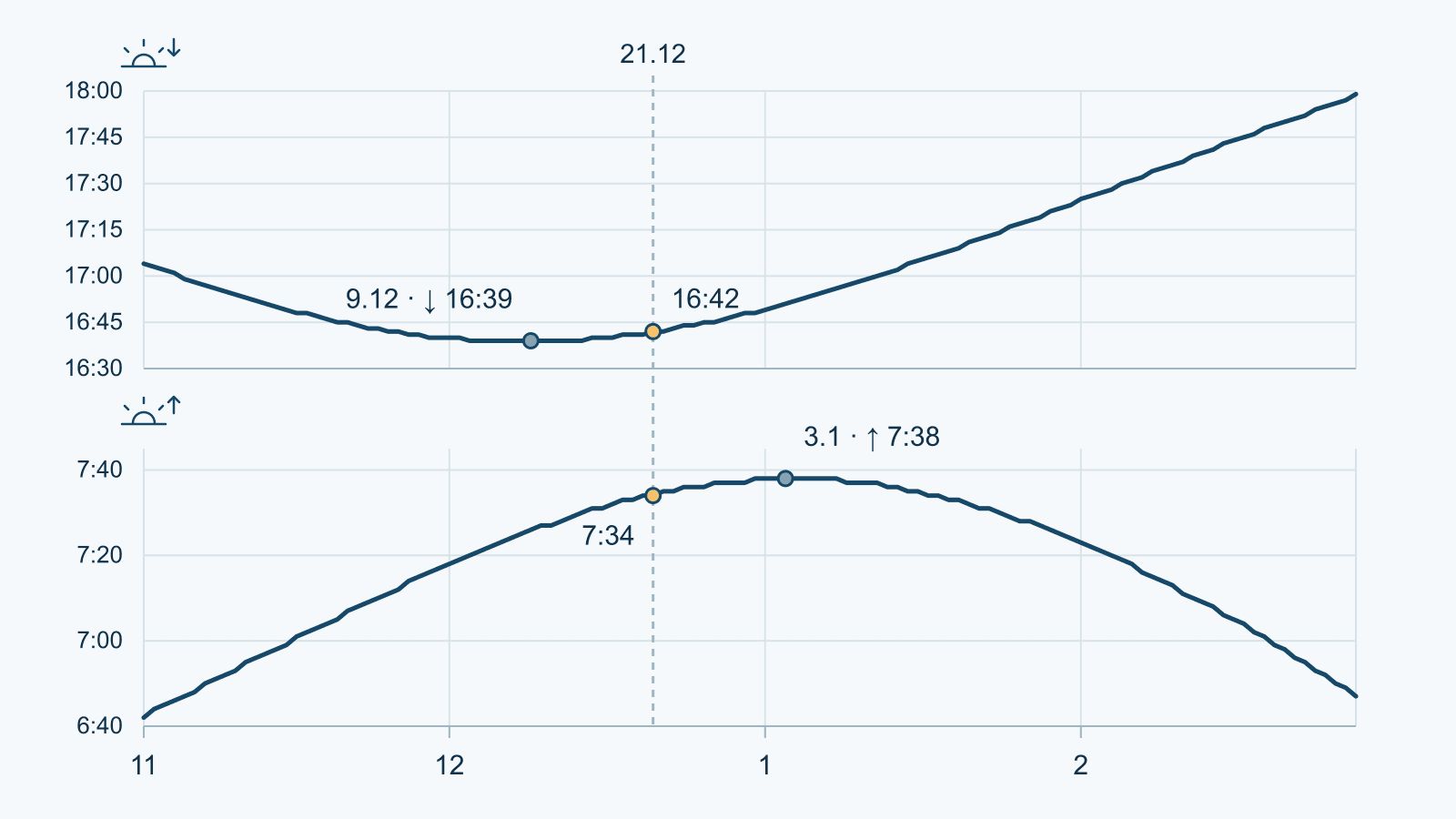
- Solar noon drifts through the year. Earth's faster motion in January makes each solar day slightly longer than 24 hours. It is one of the two reasons the earliest sunset comes before the shortest day.
Sources and related guides
- NASA's Earth fact sheet lists Earth's eccentricity, average distance, perihelion and aphelion distances, and orbital speeds.
- NASA's planetary fact sheet gives the eccentricities of the other planets and the Moon.
- NASA explains Kepler's laws of planetary motion.
- NASA Science describes how Earth's orbit changes over long cycles.
- Related SolarWatch guides: perihelion and aphelion, the solstices and the Moon's elliptical orbit and eclipse types.
See it in SolarWatch
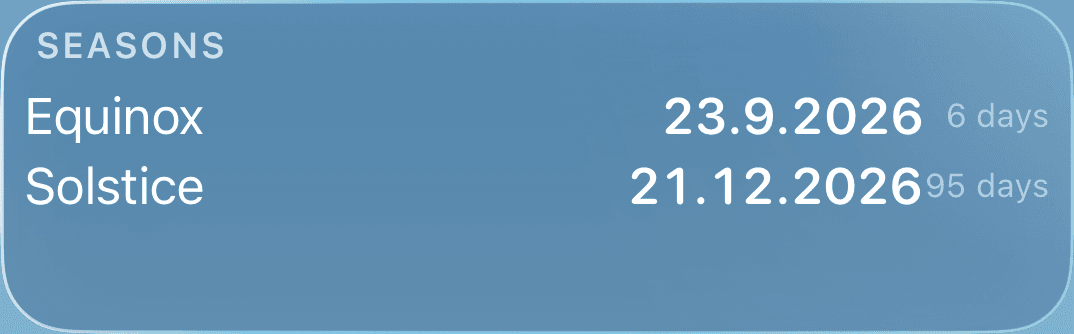
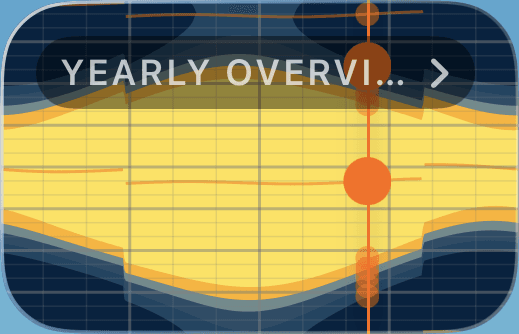
The Seasons tile shows the dates of the next equinoxes and solstices. Count the days between them and you will find that the gaps are not equal, which is Kepler's second law at work. The Yearly Overview shows how sunrise, sunset and day length change through the year where you are.
Keep reading
All guides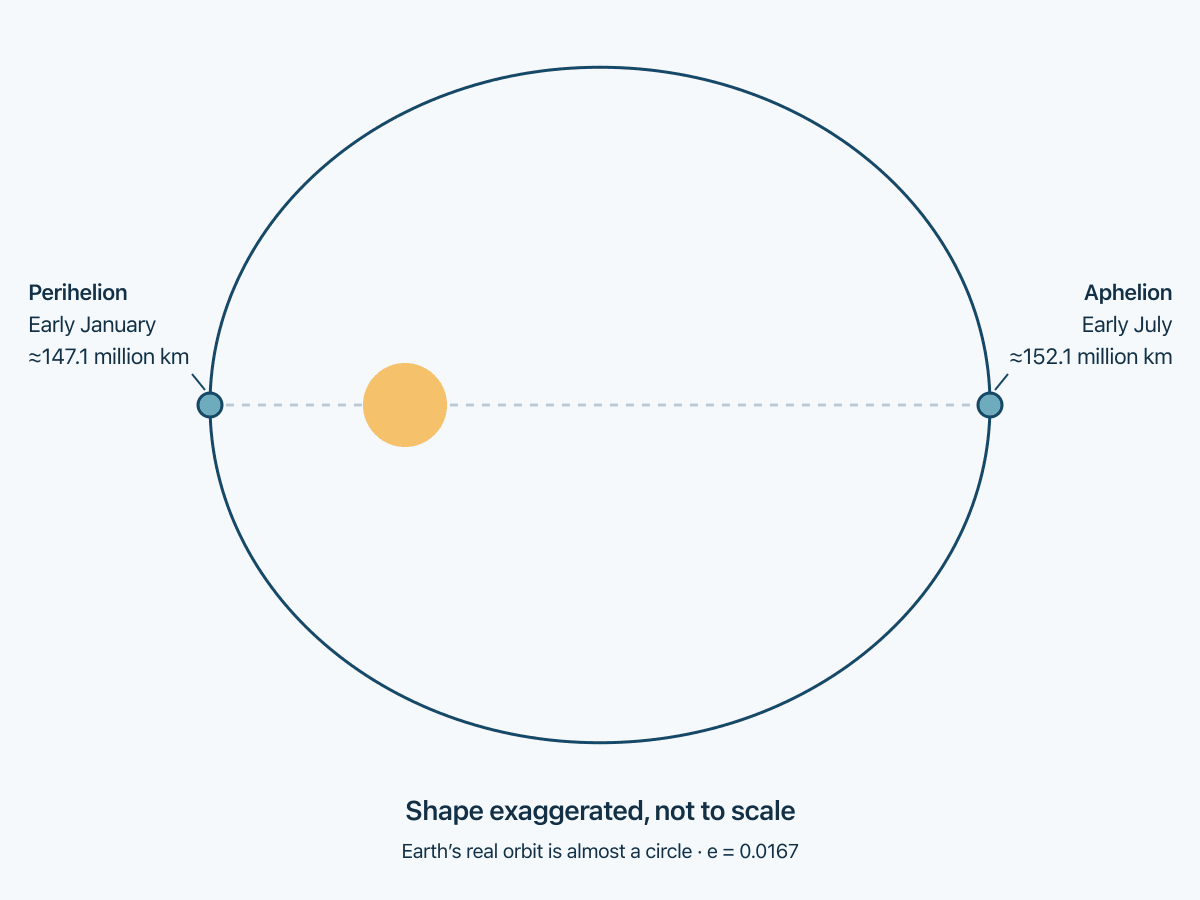
4 min read
Perihelion and Aphelion: When Earth Is Closest to the Sun
Earth is closest to the Sun in early January and farthest in early July. See the dates for the next few years and how much the distance changes sunlight.
5 min read
Why Earth Is Closest to the Sun in Northern Winter
Earth is nearest the Sun in early January, in the middle of the northern winter. Learn why distance does not cause the seasons and what the tilt of Earth's axis does instead.
6 min read
Why the Earliest Sunset Comes Before the Shortest Day
The earliest sunset of the year comes before the December solstice, and the latest sunrise comes after it. Learn why solar noon drifts and see the dates for your latitude.
6 min read
The Solstice Explained: Longest Day, Shortest Day
The solstices bring the longest and shortest days of the year. Learn what 'the Sun stands still' means, when the next solstices happen and how much daylight you get.
3 min read
The Moon's Elliptical Orbit and Eclipse Types
The Moon's distance from Earth changes through its elliptical orbit. Learn why perigee and apogee help decide whether an eclipse is total or annular.
1 min read
Seasons
Seasons · SolarWatch
1 min read
Yearly Overview
Yearly Overview · SolarWatch