
 Engin Kurutepe
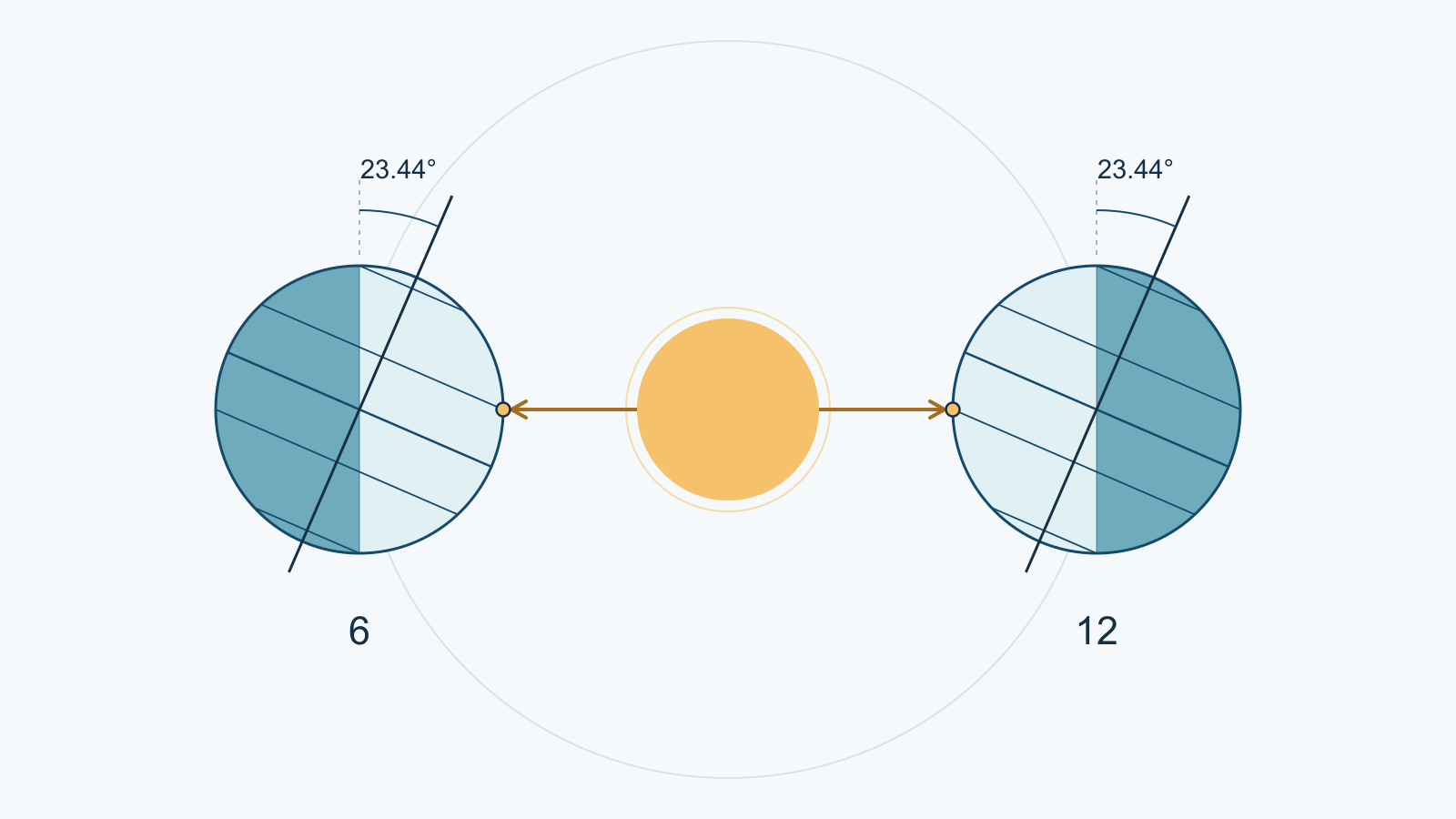
A solstice is the moment when the Sun reaches its farthest point north or south in the sky. It happens twice a year, around 21 June and around 21 December. The June solstice brings the longest day of the year in the Northern Hemisphere and the shortest day in the Southern Hemisphere. In December it is the other way around.
The cause is the tilt of Earth's axis, about 23.44 degrees. In June the North Pole leans most toward the Sun, and in December it leans most away. You can read why that tilt, and not our distance to the Sun, makes the seasons in our guide on why Earth is closest to the Sun in northern winter.
What "the Sun stands still" means
The word comes from Latin: *sol* means Sun and *sistere* means to stand still. Over the year, the Sun's height at noon changes, and so does the place on the horizon where it rises. Around the solstice that movement slows down, stops and turns back.
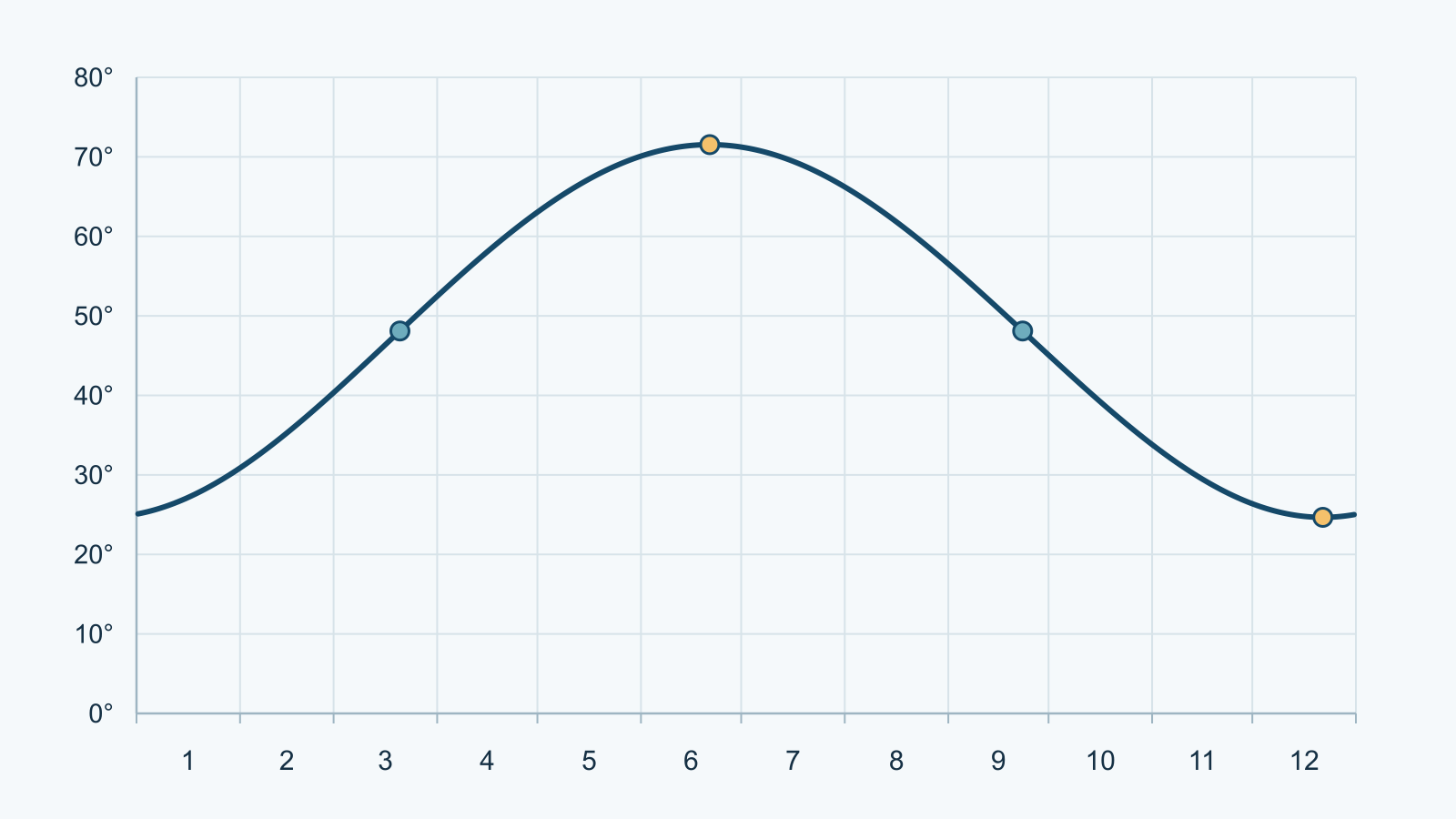
The numbers show how sharp the pause is. Near the equinoxes in March and September, the Sun's noon position shifts by about 0.4 degrees a day, almost the width of the Sun itself. In the three days after a solstice it moves only about 2 arcminutes, one sixteenth of the Sun's width. To anyone watching without instruments, the Sun seems to stand still for about a week.
A moment, not a day
The solstice is an exact instant, the moment the Sun reaches its farthest point. Calendars name the whole day after it, but astronomers give it to the minute.
| Year | June solstice (UTC) | December solstice (UTC) |
|---|---|---|
| 2026 | 21 June, 08:24 | 21 December, 20:50 |
| 2027 | 21 June, 14:11 | 22 December, 02:42 |
| 2028 | 20 June, 20:02 | 21 December, 08:19 |
| 2029 | 21 June, 01:48 | 21 December, 14:14 |
| 2030 | 21 June, 07:31 | 21 December, 20:09 |
Times are from the US Naval Observatory and given in Coordinated Universal Time (UTC). Your local date can differ. The December 2026 solstice falls on the evening of 21 December in Europe but on the morning of 22 December in Japan and Australia.
The time moves about six hours later each year, because a year of seasons lasts almost 365 days and 6 hours. Every fourth year the leap day pulls the date back again. That is why the solstices fall on 20, 21 or 22 June and 21 or 22 December.
The longest and shortest days
How much the solstice changes your day depends on your latitude. The table shows day length, from sunrise to sunset, at both solstices.
| Place | Latitude | June solstice | December solstice |
|---|---|---|---|
| Singapore | 1° N | 12 h 12 min | 12 h 03 min |
| Cairo | 30° N | 14 h 05 min | 10 h 13 min |
| Rome | 42° N | 15 h 13 min | 9 h 07 min |
| Berlin | 52° N | 16 h 50 min | 7 h 39 min |
| Stockholm | 59° N | 18 h 37 min | 6 h 05 min |
| Reykjavík | 64° N | 21 h 06 min | 4 h 08 min |
| Sydney | 34° S | 9 h 53 min | 14 h 24 min |
Near the equator the difference is a few minutes. In Stockholm it is more than 12 hours. North of the Arctic Circle the Sun does not set at all around the June solstice. In December, beyond about 67° N, it does not rise for days or weeks.
Even at the equator the day lasts slightly more than 12 hours. Sunrise and sunset are counted from the Sun's upper edge, and the air bends sunlight over the horizon, which adds a few minutes to every day.
Why the days barely change for a while
Because the Sun pauses, day length pauses too. In Berlin, the day a week after the June solstice is less than 3 minutes shorter than on the solstice itself. Around the equinoxes, Berlin loses or gains about 4 minutes every day. Our guide on how much daylight you gain each day shows how that rate rises and falls over the year.
The shortest day is also not the day with the earliest sunset. In mid-northern latitudes the earliest sunset comes one to two weeks before the December solstice, and the latest sunrise one to two weeks after it. The reason is that solar noon, the moment the Sun is highest, drifts later by about half a minute a day in late December. Our guide to why the earliest sunset comes before the shortest day has the dates for different latitudes.
Sunrise at its farthest point
The solstice also marks where the Sun rises and sets. Only at the equinoxes does it rise due east. In Rome, the June Sun rises about 33 degrees north of east, and the December Sun about 31 degrees south of east. Over half a year the sunrise point moves along the horizon by more than 60 degrees, then turns back.
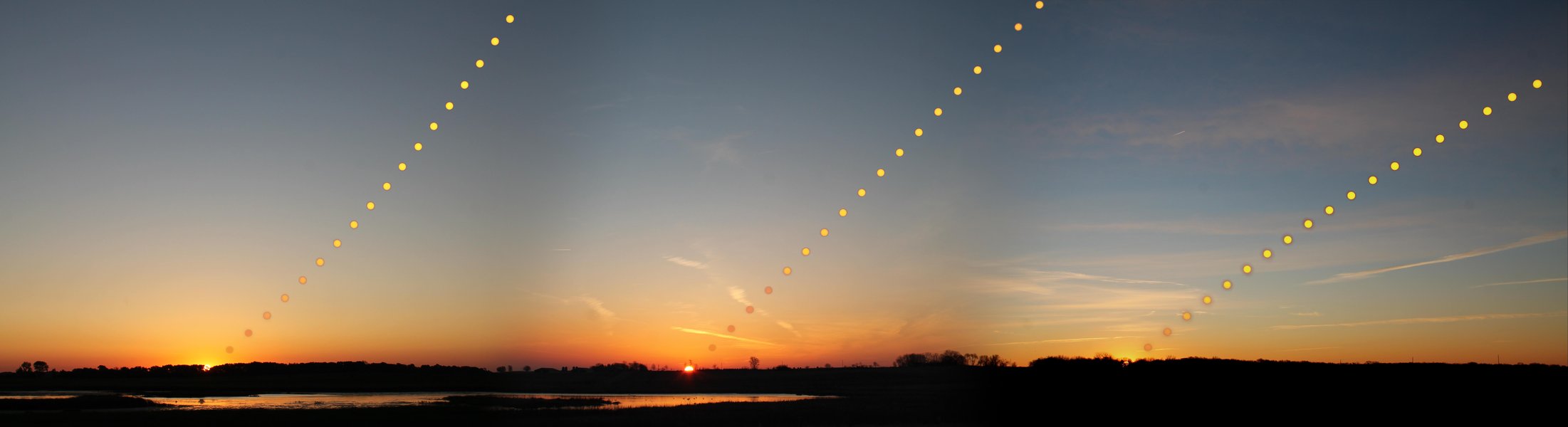
© LynceanEducation · CC BY-SA 4.0

People have marked these turning points for thousands of years. At Stonehenge in England, the main axis lines up with the midsummer sunrise in one direction and the midwinter sunset in the other. At Newgrange in Ireland, sunlight enters a small opening above the passage on the mornings around the December solstice and lights the inner chamber for about 17 minutes.
Where the Sun is directly overhead
At the June solstice the noon Sun stands straight overhead at 23.44° N, the Tropic of Cancer. At the December solstice it is overhead at 23.44° S, the Tropic of Capricorn. Between the two tropics the Sun passes overhead twice a year. Outside them it never does.
The names are about 2,000 years old. Back then the Sun stood in the constellation Cancer at the June solstice and in Capricornus in December. Earth's axis slowly wobbles, so today the Sun is in Taurus at the June solstice and in Sagittarius in December.
The polar circles come from the same angle. The Arctic Circle lies 23.44 degrees from the North Pole, at about 66.56° N. North of it, there is at least one day around the June solstice when the Sun stays up for 24 hours.
First day of summer, or midsummer
In many countries the June solstice is called the first day of summer, and in others it is called midsummer. Both make sense. Astronomers start northern summer at the June solstice and end it at the September equinox. Weather services use whole months, so meteorological summer starts on 1 June in the north.
The warmest weeks usually come a month or more after the June solstice, and the coldest a month or more after the December one. Land and especially sea take weeks to warm up and cool down, so temperatures lag behind the sunlight.
Sources and related guides
- The US Naval Observatory lists dates and times of the solstices and equinoxes.
- NASA Space Place explains what causes the seasons.
- English Heritage describes Stonehenge's solstice alignments.
- The Irish Times reports on the winter solstice sunrise at Newgrange.
- Related SolarWatch guides: why Earth is closest to the Sun in northern winter, perihelion and aphelion and how much daylight you gain each day.
See it in SolarWatch
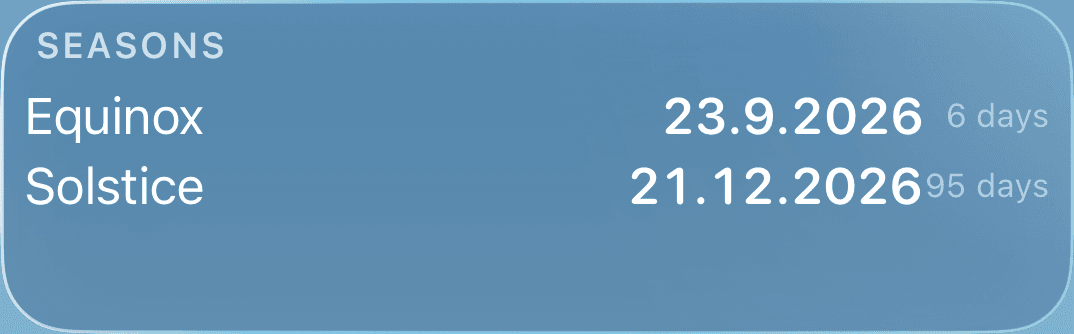
The Seasons tile shows the dates of the next solstices and equinoxes. The Daylight tile shows today's day length where you are, and the Yearly Overview shows the whole year at once. The flat tops and bottoms of its day-length curve are the solstices.
Keep reading
All guides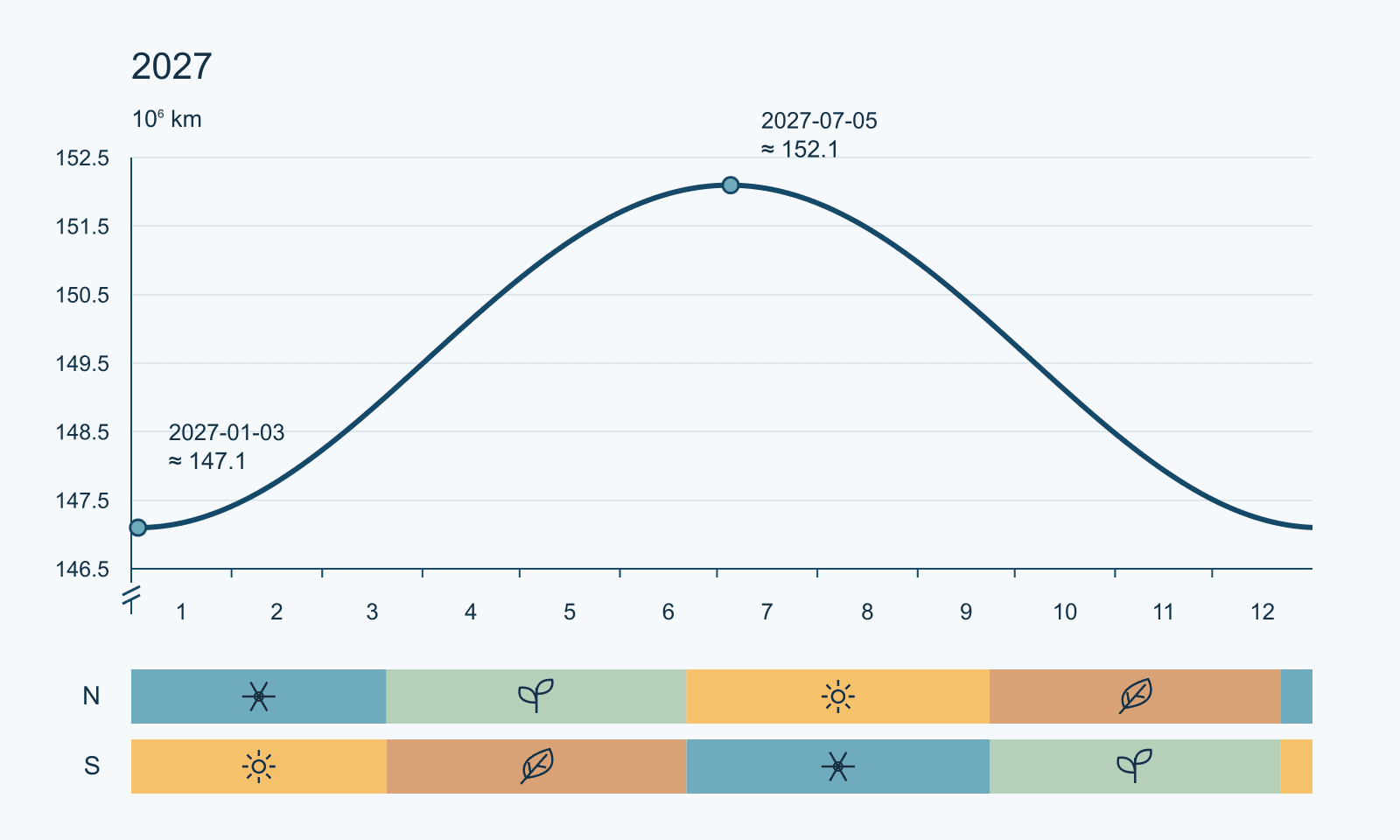
5 min read
Why Earth Is Closest to the Sun in Northern Winter
Earth is nearest the Sun in early January, in the middle of the northern winter. Learn why distance does not cause the seasons and what the tilt of Earth's axis does instead.
4 min read
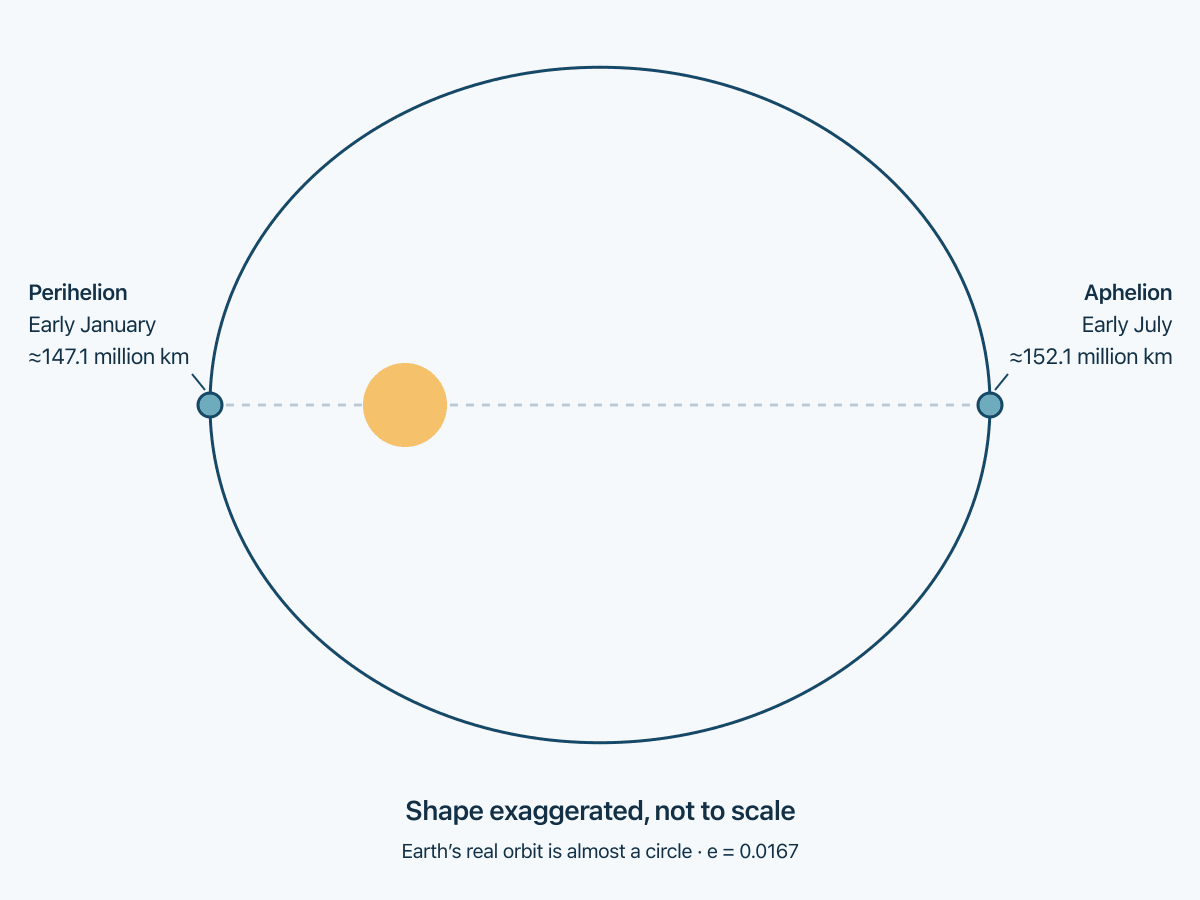
Perihelion and Aphelion: When Earth Is Closest to the Sun
Earth is closest to the Sun in early January and farthest in early July. See the dates for the next few years and how much the distance changes sunlight.
4 min read
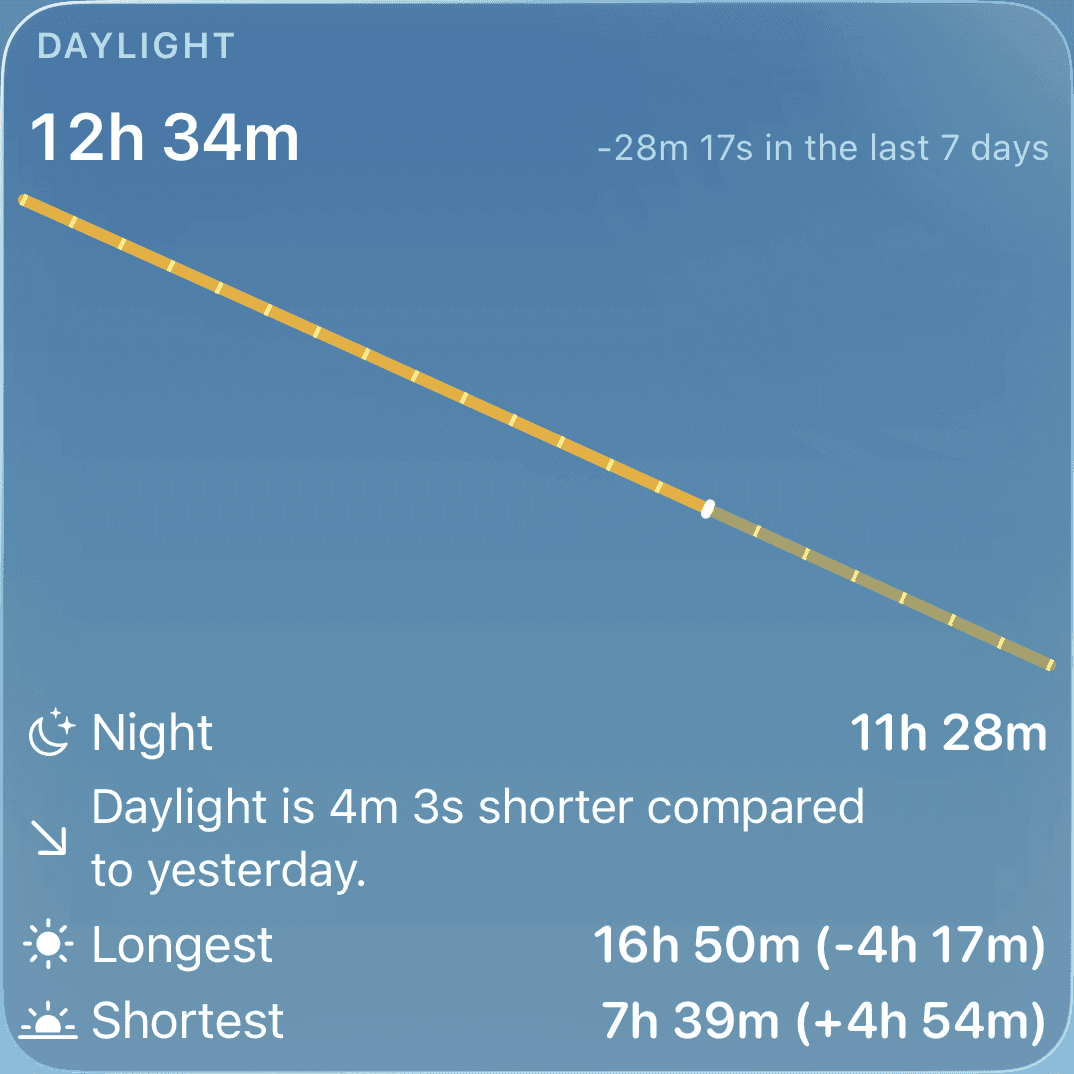
How to track how much daylight you gain or lose each day
See how many minutes of daylight you gain or lose each day, why the change is fastest at the equinoxes, and how latitude changes the numbers.
6 min read
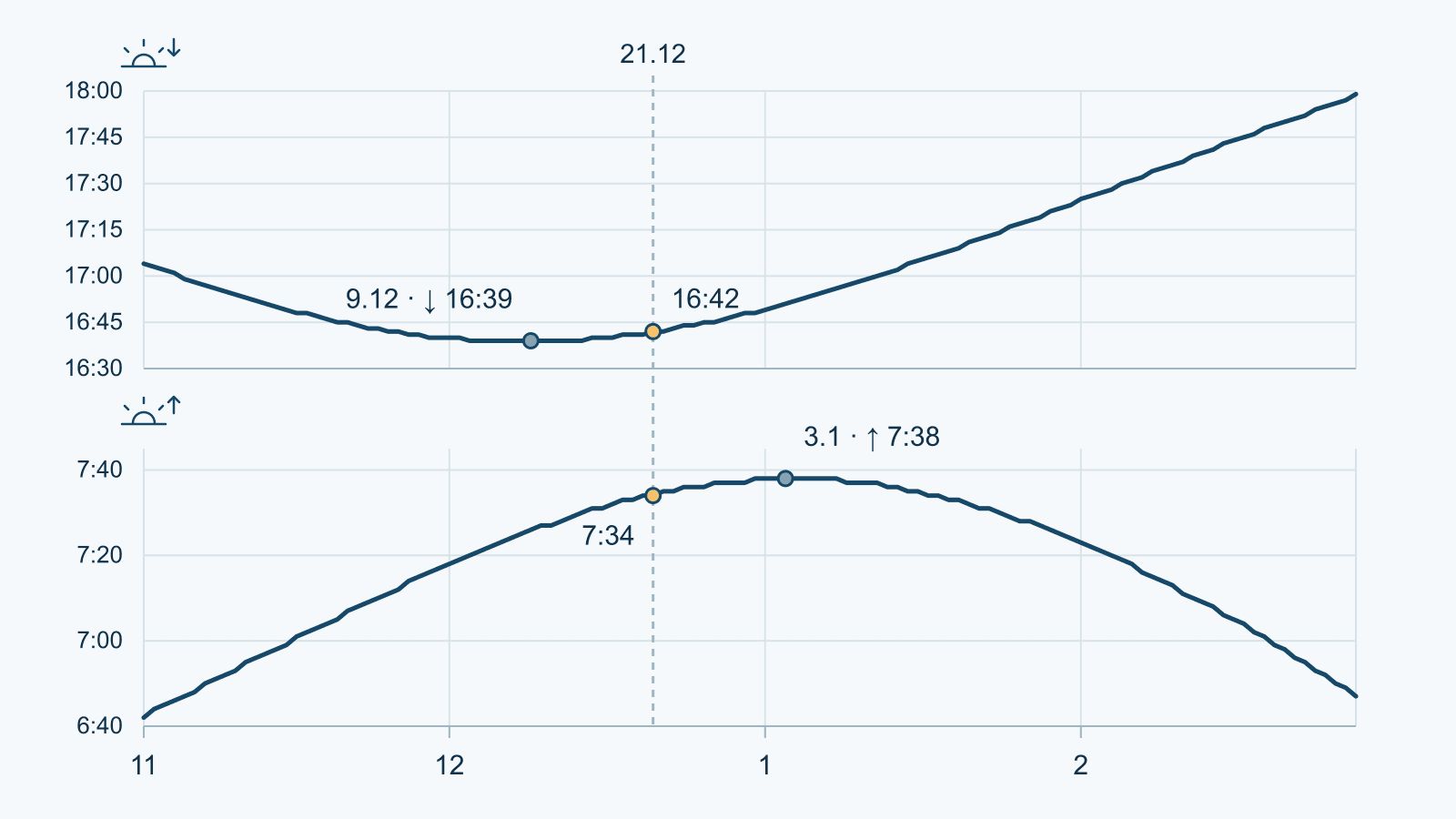
Why the Earliest Sunset Comes Before the Shortest Day
The earliest sunset of the year comes before the December solstice, and the latest sunrise comes after it. Learn why solar noon drifts and see the dates for your latitude.
1 min read
Seasons
Seasons · SolarWatch
1 min read
Yearly Overview
Yearly Overview · SolarWatch
1 min read
Daylight
Daylight · SolarWatch